Kaseya Dark Web ID vs DarknetSearch: Which Is Better for MSSPs?
➤Summary
The right dark web monitoring platform can help managed security service providers move beyond credential alerts toward broader, more valuable cybersecurity services. But how do Kaseya Dark Web ID and DarknetSearch compare?
Why Dark Web Monitoring Matters for MSSPs
Managed Security Service Providers (MSSPs) face a growing challenge: protecting multiple customers against threats that increasingly originate outside traditional corporate networks.
Stolen credentials, infostealer malware, ransomware leak sites, impersonation domains, and underground criminal communities create risks that conventional endpoint security tools cannot always detect.

Dark web monitoring helps close this visibility gap.
However, not all platforms approach the problem in the same way.
Some concentrate primarily on identifying compromised credentials and notifying customers. Others provide broader cyber threat intelligence, allowing security analysts to investigate exposures, identify emerging threats, and deliver more comprehensive security services.
Two platforms worth examining are Kaseya Dark Web ID, originally developed by ID Agent, and DarknetSearch, a threat intelligence platform developed by Kaduu.
Both support external threat monitoring, but their capabilities and operational approaches differ in important ways.
1. Kaseya Dark Web ID: A Credential-Centric Approach
In May 2019, Kaseya acquired ID Agent, a cybersecurity company specializing in identity protection and dark web monitoring solutions for managed service providers.
The acquisition brought Dark Web ID into Kaseya’s IT security ecosystem, strengthening its capabilities in compromised credential detection and identity-related risk monitoring.
Today, Kaseya Dark Web ID focuses on identifying exposed employee credentials and personal information across underground sources.
Its principal capabilities include:
- Continuous monitoring for compromised credentials.
- Detection of exposed personal information.
- Automated alerts and compromise reports.
- Integration with selected PSA and Kaseya products.
- Customer reporting and security awareness support.
For MSPs already using Kaseya products, these integrations can simplify workflows and help automate incident management.
For example, a compromised credential alert can trigger a ticket, allowing technicians to investigate whether password resets or additional identity protections are necessary.
This is particularly useful for providers offering managed IT services and basic identity exposure monitoring.
However, credential detection represents only one dimension of the external cyber threat landscape.
MSSPs providing advanced security operations may require deeper investigative capabilities and visibility across additional threat categories.
2. DarknetSearch: Moving Beyond Credential Monitoring
DarknetSearch takes a broader approach to external cyber threat intelligence.
Rather than limiting monitoring to compromised account information, its platform combines historical intelligence, live research, exposure monitoring, and investigative capabilities across multiple categories of cyber threats.
These include:
- Compromised credentials and leaked databases.
- Infostealer logs and malware-related exposure.
- Underground forums and criminal marketplaces.
- Ransomware threat actor activity.
- Telegram and Discord threat intelligence.
- Domain spoofing and brand impersonation.
- Exposed source code and cloud resources.
- External attack surface risks.
- ASM reports
The distinction matters because cyberattacks rarely involve a single isolated indicator.
A compromised password might be associated with an infostealer infection. The same organization could simultaneously face a phishing campaign using a lookalike domain, while stolen information circulates through criminal communities.
Investigating these signals together can provide a more useful understanding of the customer’s exposure.
DarknetSearch combines monitoring with search and investigation features, enabling analysts to examine findings rather than relying exclusively on automated notifications.
For an MSSP, this can turn dark web monitoring into a broader threat intelligence service.
3. Multi-Tenant Architecture: A Critical MSSP Requirement
Managing external threat intelligence for one organization is relatively straightforward.
Managing it across dozens of customers introduces a different set of requirements.
An effective MSSP platform should support customer separation, centralized administration, controlled access, and scalable monitoring.
DarknetSearch offers multi-tenant functionality in its higher-tier plans, allowing providers to manage several customer environments through a common platform.
Its published Pro plan also includes API access, webhooks, and configurable operational capacity.
These capabilities can support centralized security operations while maintaining client-specific visibility.
Kaseya Dark Web ID also provides partner-oriented administration, customer management, reporting, and integrations.
The difference is therefore not simply whether a platform supports service providers. Both do.
The more relevant question is how easily an MSSP can combine multi-customer monitoring with broader intelligence investigation and its existing security workflows.
Providers should evaluate tenant limits, asset allowances, API quotas, reporting requirements, and the operational effort involved in adding new customers.
4. Threat Intelligence Depth: Alerts Versus Investigation
Consider a practical scenario.
An MSSP receives an alert indicating that an employee’s credentials have appeared in a stolen database.
The immediate response might involve forcing a password reset, revoking active sessions, reviewing authentication logs, and verifying multifactor authentication.
But an experienced security analyst may need additional answers.
Was the information extracted by infostealer malware?
Is the exposure associated with an ongoing criminal campaign?
Are other employees affected?
Has the customer’s domain appeared in underground discussions?
Are attackers impersonating the company through suspicious domains?
Answering these questions requires investigative context.
Kaseya Dark Web ID provides compromise data, reporting, and information about discovered exposures. It also draws on intelligence from underground sources.
DarknetSearch differentiates itself through its combination of quick searches, expert searches, historical intelligence, live research, and multiple external exposure categories.
For MSSPs offering threat hunting or advanced monitoring services, this investigative flexibility can be especially valuable.
It allows analysts to move from a specific alert toward a wider assessment of the customer’s external risk.
Of course, the usefulness of any intelligence platform depends on data freshness, source coverage, accuracy, and the ability to verify findings. These factors should always be tested during a technical evaluation.
5. Brand Protection and External Attack Surface Visibility
Credential monitoring is essential, but companies can also be targeted without any employee password being exposed.
Attackers frequently register domains resembling legitimate organizations, create fraudulent websites, or impersonate trusted brands.
These techniques can support phishing, credential theft, invoice fraud, and other social engineering attacks.
DarknetSearch includes domain and brand monitoring capabilities through its SpoofGuard functionality, alongside attack surface mapping and additional exposure detection features.
Depending on the selected plan, MSSPs can also investigate suspicious domains, exposed code, cloud storage exposure, and other risks associated with a customer’s digital footprint.
This creates an opportunity to offer services extending beyond compromised credential monitoring.
For example, an MSSP could combine employee credential exposure checks with domain impersonation monitoring and periodic external attack surface reviews.
Kaseya’s broader security ecosystem includes complementary products for email security, identity management, and other protective controls.
Nevertheless, providers evaluating a dedicated external intelligence platform should consider how much coverage is available within the monitoring solution itself and how much depends on additional products.
6. Reporting: Turning Intelligence Into Customer Value
One of the most persistent challenges in managed cybersecurity is communicating value to customers.
A list of compromised email addresses may create initial concern, but it does not necessarily demonstrate continuous security improvement.
Customers increasingly expect understandable reports explaining their exposure, the significance of detected threats, and the actions taken.
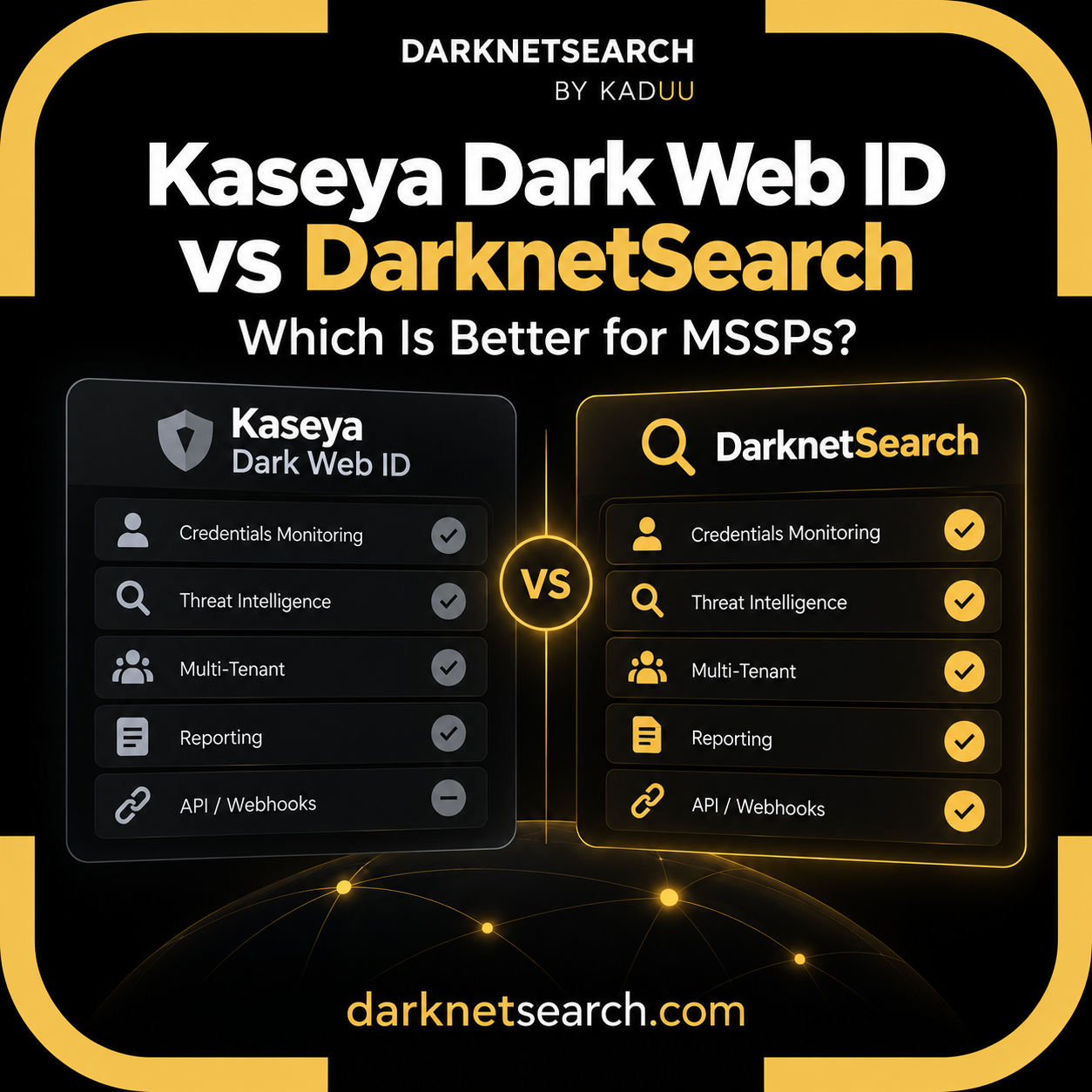
Both Kaseya Dark Web ID and DarknetSearch provide reporting capabilities.
Dark Web ID offers compromise reports and partner-oriented reporting workflows.
DarknetSearch additionally provides credential reports, attack surface reports, research reports, risk scores, and automated reporting features, depending on the subscription.
Its broader intelligence categories can help MSSPs build richer customer reviews.
For example, a quarterly report could address credential exposure, ransomware-related intelligence, suspicious domains, and changes in external risk.
This approach can support more meaningful security conversations with customers.
Instead of discussing only the number of alerts detected, the MSSP can explain what those alerts revealed and how the findings influenced security decisions.
7. APIs, Automation, and Operational Flexibility
Automation is essential when cybersecurity services scale.
Manually reviewing every finding becomes increasingly difficult as customer portfolios expand.
Kaseya Dark Web ID benefits from integration with products including Kaseya BMS, Autotask, ConnectWise Manage, and other compatible systems.
For providers operating primarily within the Kaseya ecosystem, this can be a considerable advantage.
DarknetSearch offers a different opportunity through its REST API and webhook functionality in supported plans.
This enables MSSPs to connect external intelligence with existing workflows and potentially integrate it into proprietary dashboards, reporting systems, or security automation processes.
For security providers building their own managed threat intelligence services, that flexibility is attractive.
However, API availability alone does not guarantee a successful integration.
Providers should assess documentation, authentication, rate limits, event structures, support quality, and implementation requirements before selecting a platform.
8. Which Platform Fits Different MSSP Business Models?
The choice depends largely on the services an MSSP intends to deliver.
Kaseya Dark Web ID may be a strong fit when:
- The provider already relies heavily on Kaseya tools.
- Credential exposure monitoring is the primary requirement.
- Integrated ticketing and established workflows are priorities.
- The service mainly targets standard managed IT customers.
DarknetSearch becomes particularly interesting when:
- The MSSP wants to offer broader external threat intelligence.
- Analysts need access to investigative search capabilities.
- Customers require monitoring beyond compromised credentials.
- Brand impersonation and attack surface risks are important.
- Multi-tenant operations and programmatic integration are priorities.
- The provider wants to develop differentiated threat intelligence services.
- Full ASM reports
This comparison does not imply that Dark Web ID lacks sophisticated monitoring capabilities.
Rather, DarknetSearch offers a compelling combination of investigative tools and external exposure categories for providers whose requirements extend beyond credential monitoring.
9. What MSSPs Should Test Before Choosing
A practical proof of concept is more valuable than comparing feature lists alone.
Providers should test both platforms against the same authorized customer assets and evaluate:
- Detection relevance: How many findings represent genuine, actionable risks?
- Source visibility: Can analysts understand where information originated?
- Investigation capabilities: Can a finding be researched and contextualized?
- Operational efficiency: How much time is required to manage customers?
- Reporting quality: Can findings be communicated clearly to nontechnical stakeholders?
- Scalability: How do licensing and platform limits change as the customer base grows?
Detection speed, false positives, data freshness, and total cost of ownership also deserve attention.
Neither platform should be selected solely on the basis of advertised feature coverage.
Conclusion: From Dark Web Monitoring to Managed Threat Intelligence
Kaseya Dark Web ID and DarknetSearch address an important challenge: helping organizations understand when sensitive information and external threats create cybersecurity exposure.
Kaseya Dark Web ID provides established credential monitoring capabilities and integrations that can work particularly well within the Kaseya ecosystem.
DarknetSearch presents a broader opportunity for MSSPs seeking to combine compromised credential monitoring with external threat intelligence, investigative research, brand protection, and attack surface visibility.
Its appeal is not simply the number of available features.
It is the possibility of transforming fragmented external threat signals into a structured, recurring security service.
For MSSPs aiming to differentiate themselves through deeper analysis and more comprehensive customer protection, DarknetSearch deserves serious consideration as a dedicated threat intelligence platform.
Ultimately, the best solution is the one that allows security teams to identify meaningful risks, investigate them efficiently, and translate intelligence into measurable customer value.
Learn more about DarknetSearch for MSSPs and explore how external threat intelligence can complement your existing security operations.
Discover how CISOs, SOC teams, and risk leaders use our platform to detect leaks, monitor the dark web, and prevent account takeover.
🚀Explore use cases →