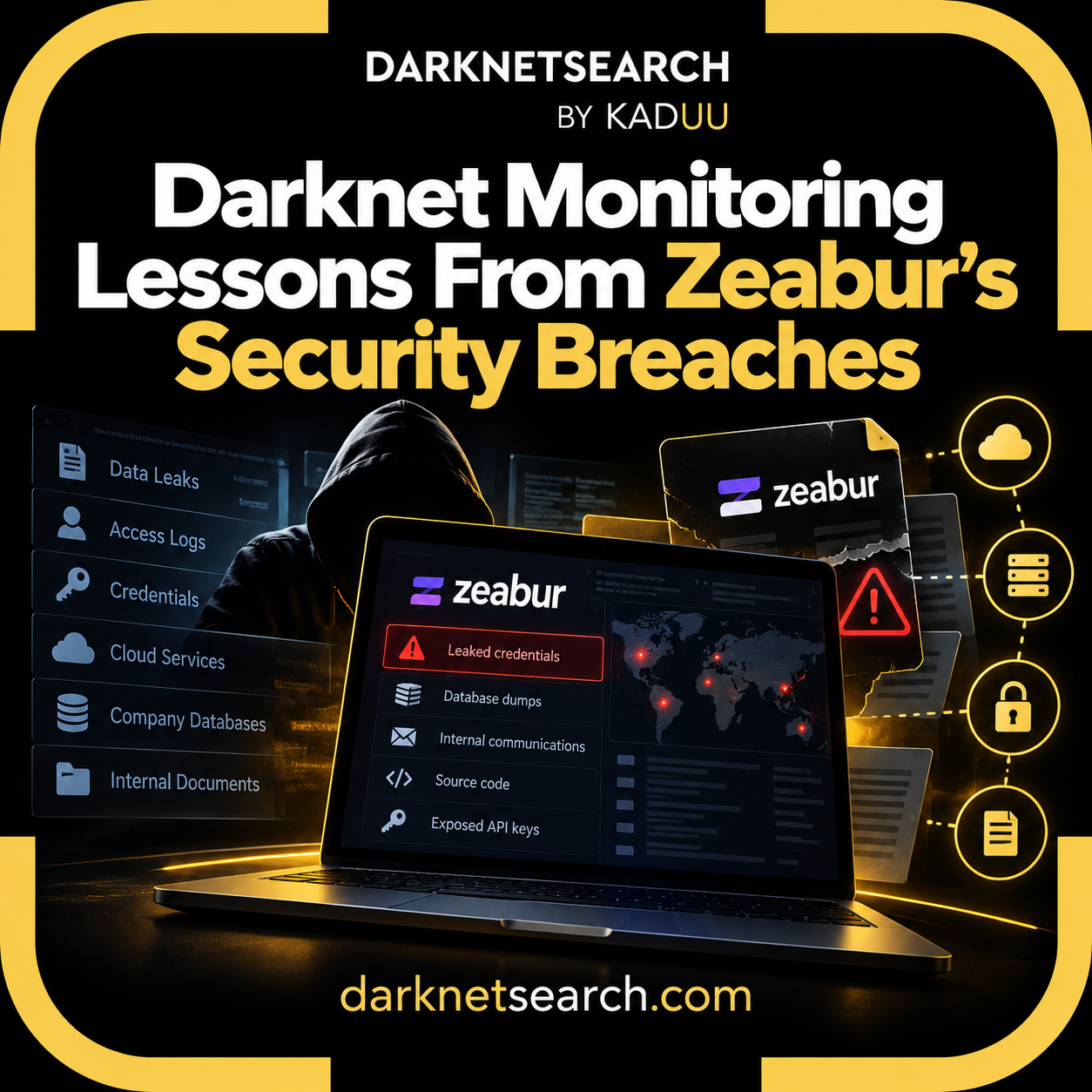
Darknet Monitoring Lessons From Zeabur’s Security Breaches
➤Summary
Darknet monitoring offers an important lesson from Zeabur’s decision to shut down after two security incidents in two months: exposed credentials and inadequate access controls can create persistent risks long after an initial breach. The developer hosting platform disclosed unauthorized access affecting internal systems and customer services in October 2026, following another incident in August. The company subsequently announced that it would wind down its services by the end of December 2026. Sources: Zeabur’s official announcement
For security teams, this case illustrates why incident response must extend beyond containing an intrusion. Organizations also need to identify exposed secrets, investigate potential data redistribution, assess downstream risks, and monitor external sources for signs that stolen information is being reused.
What Happened in the Zeabur Security Breaches?
Zeabur provides a developer hosting and deployment platform that helps users deploy applications and manage infrastructure. In August 2026, the company experienced an incident involving a vulnerability in a customer-deployed NextChat application. According to BleepingComputer, attackers used this entry point to move through inadequately isolated internal systems and access sensitive information.

A second incident occurred on October 14–15, 2026. Zeabur confirmed that an external attacker gained unauthorized access to internal systems and some customer services. The company stated that the October incident affected a broader scope than the August event. Its investigation was ongoing when the shutdown announcement was published.
The incidents were followed by a significant business decision. Zeabur announced that service shutdowns would begin on December 1, 2026, with all dedicated servers and shared clusters scheduled to stop operating by December 31, 2026.
The company cited operational complexity, security shortcomings, and the responsibilities involved in continuing to operate the platform as factors in its decision.
This is not simply a story about a hosting provider discontinuing its services. It demonstrates how weaknesses in credential management, infrastructure isolation, and post-incident remediation can compound risk across a cloud environment.
What Data and Systems Were Reportedly Exposed?
According to BleepingComputer’s October 20 report, the second incident affected 321,810 accounts and approximately 3.2 million environment-variable records. Zeabur also reported root sign-ins on 101 Google Cloud Platform servers by 92 users, SSH keys added to 50 servers, and 16 customer disk copies attached to attacker-controlled virtual machines.
These figures describe the reported scope of the incident; they should not automatically be interpreted as the number of confirmed victims or as proof that every exposed record was misused.
Environment variables can contain sensitive configuration information, including API tokens, database credentials, service passwords, and other application secrets. Their actual contents depend on how each application and deployment is configured.
If valid secrets are exposed, attackers may be able to use them to access connected services, impersonate applications, or move into other environments. The level of risk depends on the permissions associated with each secret, whether it remains valid, and what additional security controls are in place.
For affected organizations, the immediate priority is to determine which credentials and systems were exposed, rather than assuming that changing an application password alone resolves the problem.
Why the Second Breach Raises Questions About Credential Security
One of the most significant issues reported in the October incident was the use of leaked internal credentials. BleepingComputer reported that administrator tokens had not expired and had not been rotated since their creation in January 2024. Some credentials were also reportedly stored in plaintext.
Zeabur stated that the credentials used in the second incident may have been obtained during the August breach, although this connection had not been confirmed.
This distinction matters. A previous incident can expose access mechanisms that remain useful to an attacker if they are not identified and invalidated. Even when the initial entry point is closed, unrotated credentials, persistent sessions, and overlooked administrative access can leave additional routes open.
Security teams should consider several potential weaknesses:
- Long-lived credentials: Tokens without expiration dates can remain usable far longer than intended.
- Incomplete credential rotation: Changing some passwords or keys after a breach does not invalidate other exposed secrets.
- Excessive privileges: Administrative credentials can provide access far beyond the application or service where they were originally used.
- Publicly accessible management interfaces: Internet-facing administrative portals increase exposure when authentication and access restrictions are inadequate.
- Insufficient isolation: A compromised application or workload should not automatically provide a route into unrelated systems or production databases.
The lesson is that incident remediation must address both the original intrusion and the credentials, permissions, and infrastructure relationships that could enable another one.
How Darknet Monitoring Helps After a Cloud Breach
Darknet monitoring involves identifying exposed organizational information across relevant underground forums, marketplaces, breach databases, Telegram channels, paste sites, and other sources.
After a cloud security incident, monitoring these sources can complement internal investigations by helping organizations identify potential external exposure. For example, compromised credentials or database samples may appear in places that infrastructure logs cannot directly reveal.
A useful monitoring strategy focuses on information that can be linked to the organization and acted upon, including:
- Corporate email addresses and associated passwords found in exposed datasets.
- API keys, access tokens, or configuration secrets appearing in publicly accessible leak samples.
- Database records or files advertised as belonging to the organization.
- Discussions or listings that reference the organization, its domains, or its infrastructure.
- Credentials associated with employees or third-party services that may create additional access risks.
An external listing does not automatically prove that a particular account remains compromised or that every advertised record is authentic. Analysts should validate findings, assess their relevance, and correlate them with internal evidence before drawing conclusions.
Organizations seeking to understand the wider role of this discipline can explore DarknetSearch’s explanation of darknet monitoring.
How to Check If My Data Is on the Dark Web
For an organization affected by a cloud breach, checking for exposed data requires more than searching for its name. Security teams should identify the relevant assets and search for indicators that could demonstrate exposure.
A practical process includes:
- Identify affected assets. List the cloud accounts, applications, domains, databases, and third-party services connected to the incident.
- Inventory exposed secrets. Determine which API keys, tokens, passwords, and environment variables may have been accessible.
- Search relevant external sources. Investigate available breach collections, underground forums, paste sites, and other sources for matching organizational information.
- Validate discoveries. Compare potential matches against known account identifiers, timestamps, system logs, and incident findings.
- Respond to confirmed exposure. Revoke or rotate affected secrets, disable compromised accounts, and investigate suspicious access.
- Continue monitoring. Recheck relevant sources as new information and previously unseen datasets become available.
A lack of visible listings should not be treated as proof that no data was stolen. Stolen information may be traded privately, retained by an attacker, or published at a later date.
What Organizations Should Do After a Cloud Security Incident
The response to a breach should combine immediate containment with a structured investigation and longer-term risk reduction. Organizations using Zeabur or another hosting provider should establish whether their services, accounts, and data were affected before assuming that the incident applies equally to every customer.
The following actions provide a practical starting point.
- Rotate exposed credentials and revoke sessions. Replace affected API keys, access tokens, database passwords, cloud credentials, and other secrets. Revoke active sessions and invalidate old credentials wherever possible.
- Investigate cloud audit logs. Review authentication events, administrative actions, new SSH keys, unusual privilege changes, unexpected resource creation, and access to sensitive data. Preserve relevant logs for investigation.
- Review permissions and isolation. Check whether application workloads have unnecessary privileges or access to unrelated systems. Restrict administrative interfaces and apply least-privilege access controls.
- Rebuild compromised infrastructure when necessary. Where a server or workload is confirmed or reasonably suspected to be compromised, follow an incident-response plan to rebuild from trusted sources and verify that persistence mechanisms have been removed.
- Back up and migrate affected services. Because Zeabur announced a planned shutdown, customers should follow the provider’s official migration guidance, preserve required data and configurations, and test replacement deployments before services become unavailable.
- Monitor for secondary exposure. Look for leaked credentials, data samples, and other indicators that may appear after the initial incident. Findings should feed into the incident-response process rather than remain isolated threat-intelligence alerts.
These steps address different parts of the problem. Internal telemetry helps establish what happened inside an environment, while external monitoring can provide additional context about information that may have escaped organizational control.
How Businesses Can Protect Against Dark Web Threats
Organizations should treat external threat intelligence as one component of a broader security program, not as a substitute for preventive controls.
A comprehensive approach combines secure secrets management, multi-factor authentication, network segmentation, restricted administrative access, vulnerability management, endpoint detection, cloud audit logging, and tested incident-response procedures.
Darknet monitoring adds another layer by looking for exposed information outside the organization’s directly managed systems. When a potential match is discovered, analysts can prioritize it according to sensitivity, validity, privileges, and potential business impact.
For example, a leaked employee password may require account remediation, while a valid cloud administrator token could demand broader investigation across connected infrastructure. A dataset containing customer information may trigger separate privacy, contractual, and regulatory assessments depending on the circumstances.
Domain monitoring can also help identify suspicious domains that imitate a company’s legitimate online presence. Domain spoofing detection software may support brand protection and phishing investigations, although it addresses a different risk from exposed cloud credentials.
For organizations managing numerous assets or customers, these activities can be integrated into security operations workflows. Managed security service providers (MSSPs) can use relevant intelligence to support exposure reviews, prioritize remediation, and provide clients with actionable findings.
DarknetSearch provides information about its monitoring approach and related capabilities on its official website. Organizations should assess how any monitoring solution fits their existing tools, investigation requirements, and response procedures.
Frequently Asked Questions
Why is Zeabur shutting down?
Zeabur announced that it would wind down its services following two security incidents in August and October 2026. Its founder cited the complexity of maintaining the platform, security shortcomings, and the responsibilities associated with continued operations. The announced shutdown schedule begins on December 1, with dedicated servers and shared clusters scheduled to stop operating by December 31, 2026.
What should Zeabur customers do first?
Customers should determine whether their accounts, applications, or infrastructure were affected, rotate potentially exposed credentials, revoke active sessions, and investigate suspicious access. They should also back up their data and prepare to migrate services according to Zeabur’s official timeline. Customers should consult the provider’s announcements for the latest guidance on data exports, migration assistance, and support arrangements.
Can darknet monitoring prevent a data breach?
Darknet monitoring cannot guarantee that a breach will be prevented. It can help organizations identify exposed information and potential threats that appear in monitored external sources. This intelligence can support faster investigation and remediation, but it should complement preventive security controls, internal detection, access management, and incident response.
Why are exposed environment variables dangerous?
Environment variables may contain credentials, API keys, database connection details, and other sensitive configuration values. If attackers obtain valid secrets, they may use them to access connected systems or services, depending on the permissions involved. Organizations should avoid storing sensitive values in plaintext where possible, restrict access to secrets, rotate exposed credentials, and monitor for suspicious use.
Strengthen External Visibility After a Security Incident
The Zeabur incidents demonstrate why recovering from a breach requires more than closing the initial entry point. Organizations must identify exposed secrets, reassess access controls, prepare for service continuity, and investigate whether sensitive information has surfaced elsewhere.
Darknet monitoring can support this work by providing additional visibility into exposed credentials, leaked datasets, and potential threats circulating across monitored external sources. Combined with strong internal security controls, validated intelligence can help security teams make better-informed remediation decisions.
Explore DarknetSearch to learn about dark web intelligence and monitoring capabilities that may complement your organization’s exposure detection and incident-response processes.
Disclaimer: DarknetSearch reports on publicly available threat-intelligence sources. Inclusion of an organization in an article does not imply confirmed compromise. All claims are attributed to external sources unless explicitly verified.
Discover how CISOs, SOC teams, and risk leaders use our platform to detect leaks, monitor the dark web, and prevent account takeover.
🚀Explore use cases →