
Brazil Municipal Data Breach: Fortaleza Government DB Exposed

➤Summary
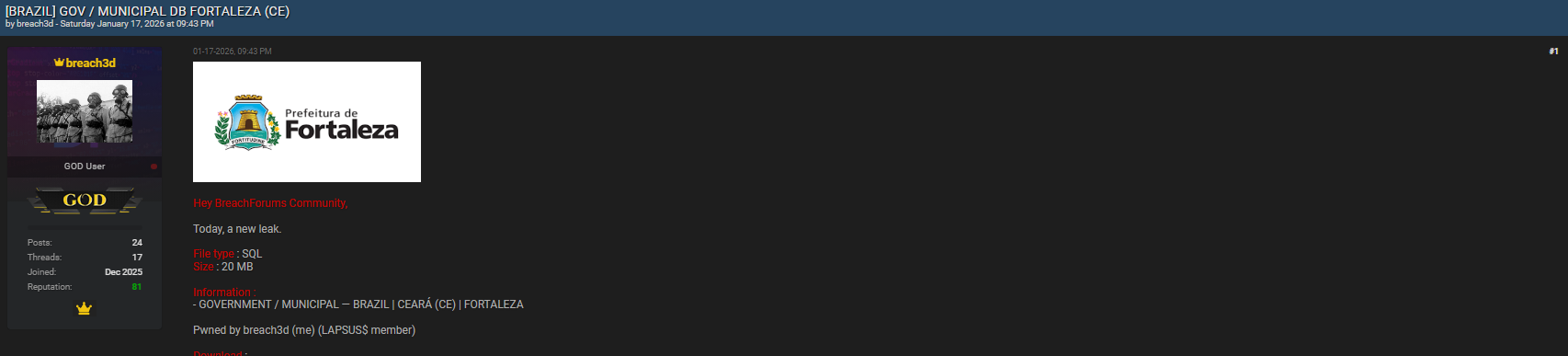
Brazil municipal data breach incidents continue to raise serious concerns about public sector cybersecurity, and the latest exposure involving the city of Fortaleza in Ceará (CE) highlights the scale of the problem. On 17 January 2026, a Brazil municipal data breach was published on breachforums.st, allegedly exposing a government and municipal database linked to Fortaleza’s public systems. Shared by a threat actor known as “breach3d,” reportedly associated with the LAPSUS$ group, the leaked SQL file contains sensitive municipal information and underscores ongoing risks to local government infrastructure. This Brazil municipal data breach is not an isolated event but part of a growing trend targeting underprotected public databases across Latin America ⚠️.
What Happened in the Fortaleza Municipal Database Leak
The disclosure appeared on breachforums.st, a well-known underground forum for breach announcements and data trading. According to the post, the attacker released a 20 MB SQL database connected to municipal government systems in Fortaleza, Ceará. While the dataset size may appear modest, the context and sensitivity of government records elevate the severity of this incident. The Brazil municipal data breach reportedly involves administrative and operational data tied to municipal services, potentially affecting citizens, contractors, and internal departments 🏛️.

Who Is Behind the Breach
The forum post attributes the leak to “breach3d,” a threat actor claiming affiliation with the LAPSUS$ group. LAPSUS$ has previously been linked to high-profile intrusions involving government agencies and major corporations. While independent verification of attribution can be difficult, the association alone increases the credibility and perceived risk of the Fortaleza exposure. A Brazil municipal data breach connected to actors of this profile often signals broader systemic weaknesses rather than a one-off mistake 🔍.
Technical Details of the Exposed File
The leaked archive is described as a raw SQL file, approximately 20 MB in size. SQL dumps are particularly dangerous because they preserve database structure, relationships, and records in a format that is easy to analyze and reuse. Even without massive record counts, a Brazil municipal data breach involving SQL data can reveal schemas, internal identifiers, and operational logic that attackers can exploit for follow-on attacks 💾.
What Type of Data May Be Included
Although the forum post does not list every field, municipal databases commonly contain:
- Administrative records and internal identifiers
- Citizen or contractor registration data
- Service request logs and timestamps
- Departmental metadata and access references
- Configuration or operational tables
In a Brazil municipal data breach, even partial exposure of such data can enable profiling, targeted phishing, or unauthorized access attempts against other government systems 📊.
Why Municipal Governments Are Frequent Targets
Local governments often operate with limited public sector threat intelligence budget and rely on legacy systems. These environments are attractive to attackers because they combine high-value data with inconsistent security controls. Fortaleza is a major city and economic hub, making its systems particularly appealing. This Brazil municipal data breach reflects a broader pattern of attackers focusing on municipal rather than federal targets due to weaker defenses 🌐.
Potential Impact on Citizens and Institutions
The immediate impact of the Fortaleza leak depends on the exact contents of the database, but risks include identity exposure, administrative fraud, and erosion of public trust. For municipal employees and contractors, leaked records could be used for impersonation or social engineering. For the city administration, a Brazil municipal data breach can result in legal scrutiny, emergency remediation costs, and reputational damage 📉.
Legal and Regulatory Implications in Brazil
Brazil’s General Data Protection Law (LGPD) applies to public entities as well as private organizations. Municipal governments are required to safeguard personal data and report incidents when there is risk to individuals. A Brazil municipal data breach involving identifiable information may trigger investigations, corrective orders, or sanctions.
Underground Distribution and Monitoring
Data leaked on forums like breachforums.st is often mirrored, resold, or repurposed across multiple platforms. This makes early detection critical. Many organizations rely on a Dark web solution to identify leaked datasets before they spread widely. Tracking mentions of municipal systems in dark web monitoring reports helps authorities and researchers understand exposure scope and attacker intent 🧠.
One Key Question Answered
Does a small SQL file still pose a serious risk?
Yes. Even a limited SQL dump can expose system structure, internal logic, and sensitive records that attackers can weaponize for further compromise.
Practical Checklist for Municipal Authorities
To reduce the impact of incidents like this, municipal IT teams should consider the following steps:
- Immediately audit exposed systems and credentials
- Isolate affected databases from public access
- Review logs for unauthorized queries or exports
- Notify legal and data protection officers
- Prepare transparent communication if citizen data is involved
This checklist helps contain damage after a Brazil municipal data breach and supports compliance efforts ✅.
The Role of Intelligence and Service Providers
Managed security providers increasingly support public entities by monitoring underground activity. Dark web monitoring solutions enable early warnings when government-related data appears on forums. Maintaining clear dark web monitoring documentation ensures response teams know how to interpret alerts and escalate incidents efficiently 🔐.
Comparing Approaches to Threat Visibility
When agencies and service providers compare dark web monitoring platforms, coverage of regional forums and government-focused leaks becomes a critical factor. Municipal breaches often surface first in niche communities, making localized visibility essential. The Fortaleza case demonstrates how quickly public-sector data can move from a single post to broader circulation 🔎.
Expert Perspective on Public Sector Security
Cybersecurity experts consistently note that municipalities face a difficult balancing act between service availability and security investment. One analyst observed, “Local governments are under constant pressure to digitize services, but security controls often lag behind that growth.” This insight aligns closely with the circumstances surrounding the Fortaleza exposure 🧠.
Staying Informed on Similar Incidents
Ongoing awareness is essential for both citizens and institutions. Platforms such as darknetsearch.com provide visibility into breach disclosures, threat actor activity, and leaked datasets. Reviewing historical cases on darknetsearch.com helps contextualize how Brazil municipal data breach incidents evolve over time and what warning signs to watch for 📈.
Key Takeaways from the Fortaleza Case
This incident reinforces that municipal systems remain high-risk targets. A Brazil municipal data breach does not need to involve millions of records to cause harm. The presence of a credible threat actor, a structured SQL dump, and public forum distribution is enough to warrant serious concern and immediate response 🔒.
Conclusion and Call to Action
The alleged exposure of a Fortaleza municipal database is a stark reminder that public-sector cybersecurity gaps carry real consequences. As Brazil municipal data breach incidents continue to surface, proactive monitoring, rapid response, and transparency are essential to protect citizens and institutions alike. Staying informed and prepared is the best defense in an evolving threat landscape. Discover much more in our complete guide. Request a demo NOW.
Discover how CISOs, SOC teams, and risk leaders use our platform to detect leaks, monitor the dark web, and prevent account takeover.
🚀Explore use cases →