
PK Water and Power Authority Data Breach: Key Facts

➤Summary
PK Water and Power Development Authority data breach discussions intensified in January 2026 after claims surfaced on an underground forum alleging a massive leak linked to Pakistan’s largest utility authority. The incident, published on Breachforums.bf by the user breach3d, points to an exposed archive allegedly containing billing and infrastructure-related data. This revelation has sparked concerns across cybersecurity circles, government stakeholders, and millions of citizens who rely on WAPDA services daily. Understanding what happened, what data may be affected, and how organizations and individuals should respond is essential in today’s threat landscape ⚠️.
This Darknetsearch.com article breaks down the facts, contextual risks, and expert-backed mitigation strategies while connecting the event to wider trends in dark web exposure and utility-sector cyber threats.
Background of the Alleged Incident
The claim was posted on 13.01.2026 on Breachforums.bf, a known marketplace for leaked databases and cybercrime discussions. According to the post, the file named “PcBillBackup102025” was shared as a .bak file inside a .rar archive with an uncompressed size of 3.31 GB. Such backups often contain structured databases, which may include customer billing records, system logs, or operational metadata.

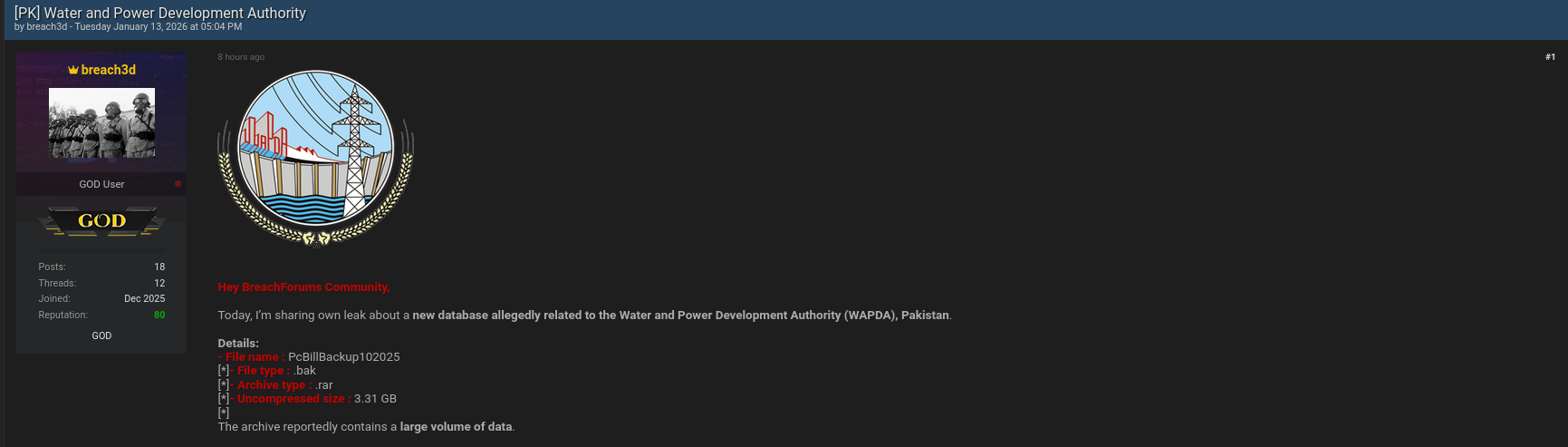
While the authenticity of the dataset has not been independently verified, the scale alone raises red flags 🚨. Historically, similar utility-sector leaks have included names, addresses, meter numbers, and consumption histories, all of which can be misused for fraud or social engineering.
Why Utility Sector Breaches Matter
A PK Water and Power Development Authority data breach is not just another leak; it potentially affects national infrastructure and public trust. Utilities are classified as critical infrastructure because disruptions or data exposure can cascade into economic and safety risks. When billing systems are compromised, attackers may gain insight into consumption patterns, internal system architecture, or even payment workflows. Cybersecurity experts warn that such data can be weaponized for phishing campaigns or extortion attempts 💡. In Pakistan, where digital transformation of utilities is accelerating, the exposure of legacy backups highlights the tension between modernization and security.
What the Forum Post Claims
According to the forum listing, the archive reportedly contains a large volume of data extracted from internal systems. The seller did not publicly disclose sample records, which is a tactic sometimes used to entice buyers while avoiding immediate takedowns. The mention of a .bak file suggests a database backup, commonly associated with SQL-based systems. This aligns with patterns seen in previous WAPDA data leak allegations, where attackers targeted outdated servers or misconfigured storage. Monitoring communities that track such posts, including references aggregated via dark web monitoring platforms, noted increased chatter following the publication date 🔍.
Potential Impact on Citizens and Organizations
If the claims are valid, the impact could be significant. Affected individuals might face targeted scams, fake utility notices, or identity misuse. Organizations working with the authority could see increased spear-phishing attempts using insider knowledge. Experts emphasize that even partial datasets can be dangerous when combined with other leaks. One analyst quoted in industry commentary stated, “Utility data provides attackers with a map of daily life—when people are home, how systems are managed, and where trust exists.” This underscores why public sector threat intelligence and response planning are essential 🔐.
Practical Checklist for Risk Reduction
To help readers quickly grasp protective steps, here is a concise checklist suitable for featured snippets:
- Verify utility communications through official channels only.
- Avoid clicking links in unsolicited billing emails or messages.
- Monitor financial statements for unusual charges.
- Organizations should audit exposed backups and access controls.
- Implement regular penetration testing and employee awareness training.
These actions do not eliminate risk but significantly reduce exposure when large-scale leaks are rumored or confirmed ✅.
How Dark Web Monitoring Fits In
Incidents like this illustrate the growing importance of intelligence gathering beyond the surface web. Specialized services track underground forums, marketplaces, and paste sites to identify leaked assets early. Terms such as dark web solutions and dark web reports often appear in industry discussions describing these capabilities. Analysts rely on curated feeds from Dark web monitoring platforms to correlate claims and assess credibility. This approach supports faster containment and informed decision-making for both public and private sectors 🧠.
Verification, Transparency, and Media Coverage
At the time of writing, no official confirmation from WAPDA has been published regarding the dataset. Responsible reporting requires caution: allegations must be verified before conclusions are drawn. However, the appearance of such claims often prompts internal investigations and coordination with national CERTs. Coverage trends show increasing dark web monitoring in press narratives as journalists seek to explain how leaks are discovered and validated. For broader guidance on handling breaches, organizations often reference frameworks from authoritative bodies such as the U.S. Cybersecurity and Infrastructure Security Agency.
One Key Question Answered
Is every forum post about a utility breach real? The clear answer is no. Underground listings range from genuine leaks to recycled or fabricated datasets. Verification requires technical analysis, sampling, and cross-referencing with known systems. That is why early warnings should trigger assessment, not panic 🛡️.
Strategic Lessons for the Future
Whether or not this specific archive proves authentic, the situation highlights systemic issues: unsecured backups, legacy systems, and insufficient monitoring. Governments and utilities must prioritize security-by-design, regular audits, and third-party risk management. Citizens, meanwhile, benefit from awareness and skepticism. Integrating early-warning intelligence with incident response plans is no longer optional; it is a baseline requirement in a hyperconnected world 🌐. Services that encourage stakeholders to contact dark web monitoring solutions after suspicious findings can accelerate containment and reduce harm.
Conclusion and Call to Action
The alleged PK Water and Power Development Authority data breach serves as a case study in how quickly sensitive claims can surface and spread in digital underground spaces. By understanding the context, potential impacts, and protective measures, readers can respond intelligently rather than react emotionally. Staying informed through trusted resources, practicing good cyber hygiene, and supporting transparent investigations are critical steps forward. Discover much more in our complete guide. Request a demo NOW.
Discover how CISOs, SOC teams, and risk leaders use our platform to detect leaks, monitor the dark web, and prevent account takeover.
🚀Explore use cases →