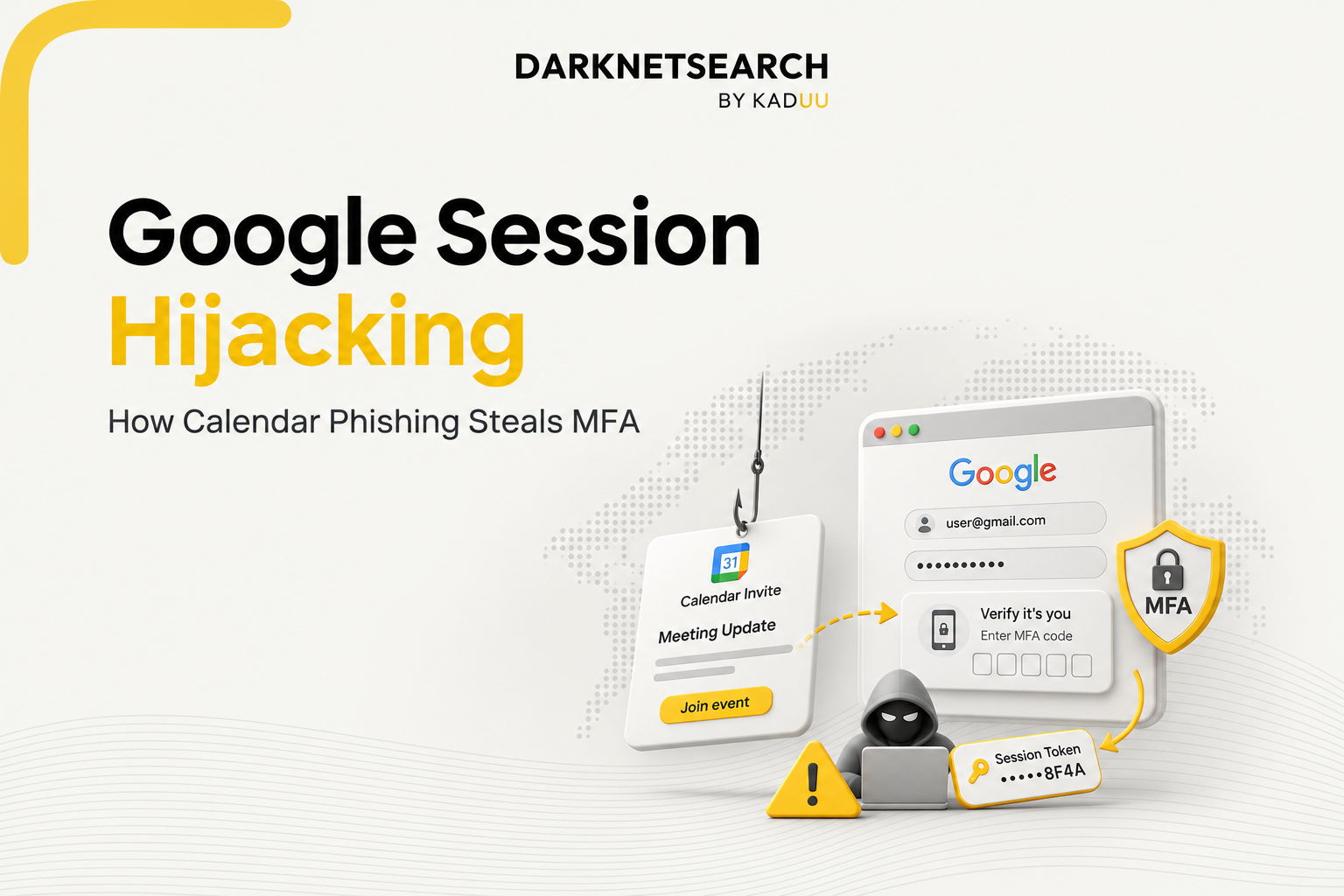
Google session hijacking has become a serious threat to enterprise cloud security after researchers uncovered a phishing campaign that uses Google Calendar invitations, trusted redirects, and live authentication proxies to capture corporate sessions. The operation demonstrates why organizations need stronger identity controls alongside external threat intelligence and credential exposure monitoring to understand risks extending beyond traditional password theft.
Tracked since August 2026, the campaign targeted Google Workspace users through invitations that appeared to originate from legitimate organizations. Researchers at Material Security identified the operation and later launched Operation CloudFire to disrupt its infrastructure.
For CISOs, SOC analysts, and MSSPs, the findings reveal how attackers can abuse trusted services, intercept authentication sessions, and potentially access corporate information without repeatedly entering stolen passwords.
What Is Google Session Hijacking?
Google session hijacking occurs when an attacker gains unauthorized control of an authenticated Google account session.
Instead of relying exclusively on stolen passwords, attackers may capture session cookies or other authentication artifacts that allow continued access after a legitimate login.
In an adversary-in-the-middle phishing attack, a malicious proxy relays authentication traffic between the victim and the genuine service.
The victim sees a familiar login process while the attacker attempts to capture credentials and session information.
The consequences can extend beyond Gmail.
Depending on the compromised account’s permissions, an attacker may potentially access Google Drive, corporate correspondence, connected applications, and OAuth-authorized services.
How Operation CloudFire Targeted Google Workspace Users
Material Security identified the campaign in August 2026 and documented its evolution through September and October.
The attackers combined trusted Google services with malicious infrastructure designed to appear harmless to conventional security controls.
1. Google Calendar invitations delivered the phishing lure
The initial messages appeared as calendar invitations, sometimes sent through compromised accounts belonging to organizations the recipient already knew.
Their subjects included everyday business scenarios:
- Missed voicemail notifications.
- Requests for proposals or information.
- Court-related notifications.
- Outstanding payment reminders.
- Shared documents and business correspondence.
These ordinary subjects made suspicious invitations less conspicuous in busy corporate calendars.
Because some messages originated from previously compromised accounts, recipients could recognize the sender’s name or organization.
2. Legitimate Google URLs disguised the destination
Many invitations contained links beginning with legitimate Google domains.
The attackers abused redirect functionality to send victims toward attacker-controlled infrastructure.
Other campaign variants used Google Drive sharing links, share.google URLs, or trusted transaction-notification services.
A familiar initial domain therefore did not guarantee a safe final destination.
This technique complicates detection systems that rely heavily on the reputation of the first URL.
3. Cloudflare challenges concealed malicious pages
The infrastructure incorporated Cloudflare Turnstile challenges before presenting the phishing content.
Some implementations used genuine Cloudflare functionality.
After the visitor completed the challenge, JavaScript constructed the next stage inside the browser.
As a result, automated scanners inspecting the initial response could miss the malicious authentication interface.
4. A live proxy captured authentication sessions
The final stage placed an attacker-controlled reverse proxy between the user and Google’s legitimate authentication service.
The user entered credentials and completed supported authentication challenges.
The proxy relayed those interactions while attempting to capture the resulting session.
Researchers associated the attack infrastructure with the Nyasher phishing framework.
Why This Google Session Hijacking Campaign Bypassed Traditional MFA
Traditional multifactor authentication adds an important security layer, but not every authentication method provides equal protection against live phishing proxies.
An adversary-in-the-middle proxy can relay time-based verification codes, SMS codes, and certain approval prompts to the legitimate authentication service.
The attacker may then obtain authenticated session material.
This differs from simply guessing or stealing a password.
However, the technique does not establish that every MFA mechanism can be bypassed.
Origin-bound, phishing-resistant authentication methods, including correctly implemented FIDO2 security keys and passkeys, provide stronger protection against this type of proxy-based credential interception.
Organizations should therefore prioritize phishing-resistant MFA for privileged accounts and sensitive enterprise applications.
Operation CloudFire: What Researchers Discovered
Material Security conducted an extensive investigation into the infrastructure supporting the campaign.
Its researchers tracked malicious URLs, registration patterns, compromised sending accounts, and changing phishing techniques.
The original Operation CloudFire research from Material Security reported the following results over approximately one month:
| Investigation metric | Reported result |
|---|---|
| Campaign messages blocked | 68,676 |
| Unique malicious URLs analyzed | 2,112 |
| Domains taken down | 897 |
| Compromised sender addresses observed | 8,570 |
| Root domains associated with those addresses | 6,354 |
These figures describe the researchers’ observed campaign activity, not the total number of confirmed victims worldwide.
The operation also demonstrated how quickly attackers could replace infrastructure.
New domains and endpoints were prepared shortly before phishing waves, limiting the usefulness of static blocklists.
Researchers worked with Cloudflare to disrupt identified malicious infrastructure and display phishing warnings to potential victims.
By late October, the observed campaign appeared to have dispersed, although the researchers cautioned that similar operations could emerge.
Why Stolen Google Sessions Threaten Enterprise Security
An authenticated Google Workspace session may provide access to more than an employee’s inbox.
Attackers controlling a session could potentially read sensitive messages, access shared documents, impersonate the account owner, or attempt to authorize additional applications.
Business email compromise
Access to corporate correspondence can help attackers understand financial relationships and internal procedures.
This information may support convincing fraudulent payment requests or further impersonation attempts.
Cloud data exposure
Google Drive can contain contracts, internal documentation, financial records, and other business information.
Unauthorized access could create confidentiality risks even without a broader infrastructure compromise.
OAuth application abuse
Attackers may attempt to authorize malicious third-party applications using the compromised account’s permissions.
Such access can potentially persist beyond an individual browser session unless administrators review and revoke unauthorized grants.
These risks make session management and authentication monitoring critical components of cloud security.
How Threat Intelligence Supports Session Hijacking Investigations
Traditional incident response focuses on authentication logs, endpoints, and affected cloud accounts.
External threat intelligence provides complementary information about compromised identities, suspicious infrastructure, and known phishing activity.
For example, DarknetSearch offers credential and stealer log monitoring to help organizations investigate passwords, authentication tokens, and session artifacts found in monitored external sources.
This distinction matters.
Operation CloudFire used live phishing proxies rather than relying on a confirmed infostealer infection.
A session stolen through a live proxy will not necessarily appear in an infostealer dataset or dark web marketplace.
Nevertheless, monitoring exposed credentials can help SOC teams identify related identity risks and prioritize investigations.
DarknetSearch also examines credential-focused attacks in its article on AWS phishing threats and stolen cloud credentials.
Why Employee Awareness Still Matters
The campaign exploited familiar workplace activities, particularly calendar invitations and shared-document notifications.
Employees could encounter malicious content while performing ordinary business tasks.
Security awareness programs should therefore include scenarios involving unexpected invitations, suspicious sharing requests, and authentication prompts.
Practical security awareness training can reinforce habits such as independently verifying unexpected requests, checking final website destinations, and reporting suspicious invitations.
Training remains a complementary measure.
It cannot replace phishing-resistant authentication, session controls, or technical detection.
How SOC Teams Can Detect Suspicious Google Workspace Sessions
Organizations should investigate authentication and session activity that differs from normal user behavior.
Relevant warning signs include:
- Logins from unfamiliar locations or infrastructure.
- Unexpected authentication activity following calendar invitations.
- Unusual Google Drive access or downloads.
- New OAuth applications receiving sensitive permissions.
- Suspicious mailbox rules or forwarding changes.
- Repeated session creation or unexpected authentication events.
Google Workspace audit logs and identity-provider telemetry are essential for validating these indicators.
SOC teams should correlate suspicious events rather than treating every unfamiliar IP address as proof of compromise.
Security teams can also review reported phishing domains and suspicious redirects to identify exposure across their organizations.
How to Respond to a Suspected Hijacked Session
When session theft is suspected, speed and coordinated containment are essential.
- Investigate the account. Examine recent authentication events, suspicious sessions, and abnormal Google Workspace activity.
- Revoke active sessions. Use administrative controls to invalidate suspicious access and associated authentication artifacts where supported.
- Reset credentials. Change potentially compromised passwords and review recovery settings.
- Audit OAuth permissions. Remove unauthorized third-party grants and inspect application activity.
- Review accessed information. Identify potentially exposed messages, documents, and shared resources.
- Strengthen authentication. Deploy phishing-resistant MFA and reinforce secure account recovery procedures.
Organizations should preserve relevant evidence before completing remediation.
A password reset alone may not invalidate every previously issued token or application authorization.
Frequently Asked Questions
What is Google session hijacking?
Google session hijacking is the unauthorized use of an authenticated Google account session.
Attackers may obtain session cookies or authentication artifacts through phishing proxies, malware, or other compromise methods.
Successful session theft can potentially provide access to Gmail, Google Drive, and connected services without requiring the attacker to complete every authentication step again.
Can hackers bypass Google MFA using phishing?
Certain phishing proxies can relay passwords and traditional MFA challenges to the legitimate authentication service.
This may allow attackers to capture an authenticated session after the user completes the login.
Phishing-resistant methods such as properly implemented FIDO2 authentication provide stronger protection because they bind authentication to the legitimate website origin.
How did Operation CloudFire use Google Calendar?
Attackers distributed malicious invitations containing links that appeared to originate from trusted services.
Recipients were redirected through several stages toward attacker-controlled phishing infrastructure.
A live proxy then attempted to capture Google authentication sessions.
Material Security documented thousands of malicious URLs and disrupted hundreds of associated domains.
Can dark web monitoring detect stolen Google sessions?
Dark web monitoring can identify certain exposed credentials, cookies, or tokens when they appear in monitored sources.
However, a session stolen through a live phishing proxy may never be publicly distributed.
Organizations should combine external intelligence with Google Workspace audit logs, phishing-resistant MFA, and active session monitoring.
Strengthen Visibility Into Compromised Identities
Operation CloudFire demonstrates how attackers can exploit trusted communication channels and legitimate authentication processes to compromise corporate accounts.
Organizations need more than password monitoring. Effective protection combines phishing-resistant MFA, session investigation, cloud activity monitoring, and external intelligence about compromised identities.
DarknetSearch helps security teams investigate exposed credentials, stealer logs, and related external threats to complement existing SOC workflows.
Explore these capabilities or request a DarknetSearch free trial to assess how continuous threat intelligence can improve visibility into identity-related cyber risks.