A Telegram channel using the Dark Storm Team name has posted Outlook outage screenshots, availability checks and an apparent attack panel targeting Microsoft’s webmail. The posts introduce a named actor apparently claiming a role in the disruption. They do not establish who caused it.
Independent monitoring confirms widespread failures during the Microsoft 365 outage of 12–13 November. Microsoft says it is not aware of malicious activity causing the incident. We assess the attribution evidence as low, but the claim is specific enough to examine against the public timeline.
Both a genuine attack and an opportunistic claim are compatible with these screenshots. Distinguishing them requires evidence beyond the channel’s own posts.
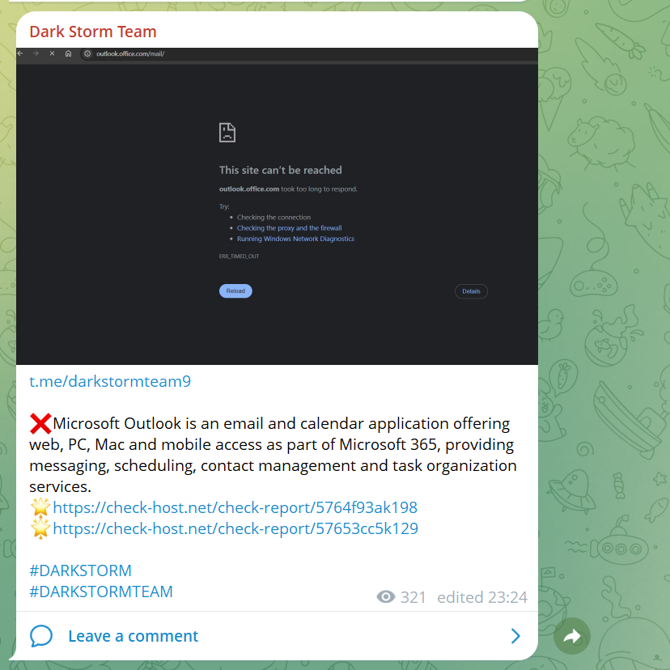
Figure 1. A post under the Dark Storm Team name shows an Outlook connection error and links to Check-Host reports. Source: supplied Telegram screenshot.
What the group is showing
The initial post identifies outlook.office.com/mail/ and displays a browser timeout. A follow-up, beneath a November 13 date separator, shows an interface labelled “TLS – Layer 7 (HTTPS)” with outlook.live.com/mail/ as its target. Its accompanying message implies that Microsoft is struggling to restore the service. Read together, the posts appear intended to associate the group with the outage.
That is more specific than a generic threat against Microsoft. However, the two posts name different webmail endpoints, and neither image establishes the scope of any attack. The panel does not show verifiable execution logs, measured traffic or a demonstrated effect on Microsoft’s infrastructure.
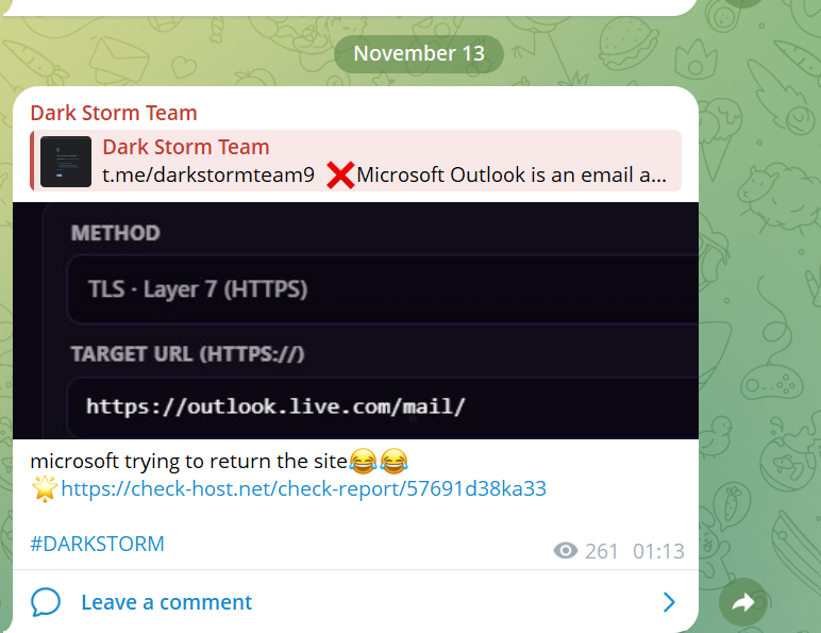
Figure 2. The follow-up displays an apparent attack configuration targeting outlook.live.com. The visible panel is evidence of a claimed method, not proof that the method caused disruption.
Other supplied posts announce an alliance with Tunisian Maskers and advertise paid DDoS services. These provide context for the channel’s positioning and a possible commercial incentive to publicize outages. They do not independently verify its capability or responsibility.
The timing is the strongest test available
ThousandEyes observed widespread Microsoft 365 availability problems from approximately 17:30 UTC on 12 November, including timeouts, connection failures and server errors. The Check-Host report reproduced in the supplied evidence is timestamped 22:22:49 UTC that evening, roughly four hours and 53 minutes later.
The displayed check therefore documents conditions during an outage already under way. It does not demonstrate that Dark Storm Team started it. Equally, a later check cannot rule out an earlier attack: that would require an authenticated earlier record and independent corroboration.
The report also shows mixed results, with timeouts and a server error alongside successful HTTP redirects. This supports uneven reachability at that moment. It does not identify the cause of those failures, and a redirect alone does not establish that a user could access a mailbox.
Telegram clock times in the screenshots have no visible timezone, and the initial post is marked edited. The explicit UTC timestamp on the Check-Host report is therefore the safer point of comparison. The screenshots cannot establish who first claimed involvement.
Microsoft reports an infrastructure problem
Microsoft’s 13 November update, reproduced from its service health feed by the University of Pennsylvania, reports improved server stability after a patch to an upstream authentication and routing component. The incident references are EX1550543 and MO1550821. Its statement is explicit: “As of now, we are not aware of any malicious activity that is causing this incident.” A fuller root-cause account is promised after mitigation.
That statement carries more evidential weight than a Telegram claim because Microsoft can inspect the affected systems. It is still a contemporaneous incident assessment, rather than the final post-incident report. The current public record favors an internal infrastructure explanation; it does not independently settle whether someone also attempted an attack during the disruption.
A DDoS explanation is technically possible
Microsoft has previously confirmed that Layer 7 DDoS attacks temporarily affected service availability in June 2023. That case shows that its scale does not make disruption impossible. Microsoft attributed the earlier activity to Storm-1359; the similar wording is not evidence of any connection to Dark Storm Team. Historical precedent establishes plausibility, not attribution for November 2026.
Our rating of the attribution evidence
2 out of 5 | Low confidence
This rates the strength of the evidence connecting Dark Storm Team to the outage. It is not a 40 percent probability estimate. On this editorial scale, 1 means an unsupported assertion, 2 means a specific claim with circumstantial material, 3 requires independent corroboration of attack activity, 4 requires a strong causal link, and 5 requires independently verified attribution.
The claim reaches level 2 because it identifies concrete targets, supplies availability checks and displays an apparent attack method. It does not reach level 3 because none of that independently demonstrates that the group generated the traffic responsible for the disruption. The outage is corroborated; the actor’s role is not.
A higher rating would require authenticated attack records aligned with the start of impact, independent observations of matching malicious traffic, or findings from Microsoft or a provider linking that traffic to the failures. Evidence of an attempted attack alone would still leave its contribution to the wider outage unresolved.
A named claimant leaves an open question
Dark Storm Team gives this story a named claimant to investigate. Public evidence has not established that it was the first group to claim a role, or that it caused the disruption.
Readers can weigh the specific target and method against the late availability check, the absence of independently verified attack data and Microsoft’s account. The posts could reflect a real attack, an attempt that overlapped with an unrelated failure, or an effort to claim credit for an outage already in progress. For now, the last step from claim to cause remains unproven.
Sources and evidence
[1] Five supplied screenshots showing the Dark Storm Team channel, an alliance announcement, Outlook posts, a Check-Host report and a DDoS service advertisement. Figures 1 and 2 reproduce two of those screenshots without alteration. The underlying posts were not independently authenticated.