A group calling itself the Handsome Boy Hacking Club listed FIFA on 20 November 2026 and, the next morning, posted a collection it described as a 12.2 GB export from FIFA’s Microsoft systems. FIFA has not confirmed an incident, and no official statement was found. The claim that FIFA’s systems were breached is unverified. This note is a review of a copy of that published collection, which we obtained and examined.
The copy contains 2,460 files and 13.15 GB. About 83 percent of that volume is slide decks and training video. The harm is in a much smaller set of files.
Identity documents account for 69 MB: 169 files titled as passports and 116 titled as visas. They opened as real document images, including material for senior officials and people travelling with them. Names and images are withheld. Travel files include tickets, hotels and three private-jet manifests. Council planning for November and December 2026 was still being edited on 11 November. A workforce pack for the U-17 tournament in Qatar took effect on 5 November and includes a venue wireless password, which is withheld.
Commercial files include negotiation notes with DoorDash and Doc.com, unpublished revenue workbooks, and screenshots of an internal dashboard. The dashboard displays 106.0 million registered customers, $1.9 billion in ticket revenue and $343.3 million in hospitality revenue. The customer list behind that screen is not in the archive.
The documents read as a FIFA working library from Microsoft 365. Failed-download notices inside the copy are timestamped 12 November, nine days before publication. Whether they came from FIFA’s own tenant or from a supplier is unverified. There is no ransom note and no sign of encrypted match systems. This is not the June 2026 exposure of World Cup broadcast controls.
If the files are misused, the people exposed are those in the identity and travel documents, staff and freelancers, FIFA under Swiss and European privacy law, and commercial counterparties whose negotiating positions are in the papers. Match results are not shown to be at risk.
| In brief | Review |
| Status | Unverified by FIFA. Collection obtained and reviewed. |
| Files / unpacked size | 2,460 files · 13.15 GB |
| Identity files | 169 passport-titled, 116 visa-titled |
| Most serious harm | People in those files, and current travel plans |
| What it is not | A stolen list of 106 million customers, or a match-integrity breach |
The pages after this one are the full assessment. Identity documents, bank details and passwords are not included.
Research paper
The FIFA collection
What was published on 21 November 2026, how serious it is, and who can be harmed
This paper examines the archive a group calling itself the Handsome Boy Hacking Club attributed to FIFA and offered on a clearnet forum on the morning of 21 November 2026. The copy reviewed here is the unpacked tree: 2,460 files and 13.15 GB. The files are genuine FIFA working documents. The harm sits in a few hundred identity, travel, and commercial files, not in the gigabytes of slide decks and training video that make up most of the size.
| Measured size | Files | Judgment |
| 13.15 GB unpacked | 2,460 | High for people and for commercial confidentiality |
Identity documents, bank coordinates, archive passwords, and venue passwords are not reproduced. Names of private individuals are not listed. One public office is named, once, to show the seniority of the identity files.
What the files settle
| Finding | Where it is shown |
| Genuine FIFA working files, from a Microsoft 365 download on 12 November | Sections 4 and 6 |
| 169 passport-titled files and 116 visa-titled files; none are reproduced | Sections 7.1 and 11 |
| 106 million customers is a dashboard tile, not a stolen table | Sections 7.4 and 11 |
| High for people and for commercial confidentiality. Low for match integrity. | Sections 9 and 10 |
Contents
A one-page briefing, written so it can be shared with the press, is the first page of this document. The assessment itself begins below.
- Judgment
- The public record, and where it stopped
- How the files were examined
- What kind of collection this is
- Size, and why the size misleads
- Evidence that the material is genuine
- What the documents show
- What this adds to the public record
- How critical it is
- Who can be harmed
- Samples
- Limits
- What should be done with this
- Sources
1. Judgment
The collection is a real library of FIFA working files, copied out of a Microsoft 365 environment. It is a protocol office, a commercial team, a legal folder, and an IT policy set, plus the scans and tickets those teams use. It is not a stolen table of 106 million fans, and it is not a ransomware encryption of match systems.
On seriousness, the archive should be read by harm rather than by gigabytes. Identity documents are 69 MB, about half of one percent of the volume, and they are the sharpest risk: 169 files titled as passports and 116 titled as visas. Travel bookings and a council workbook covering November and December 2026 were still current on the day of this review. A workforce pack for the U-17 tournament in Qatar is dated the first half of November 2026 and includes a venue wireless password. Commercial workbooks record negotiation positions and revenue forecasts. Two screenshots show an internal dashboard over a registered-customer base of 106.0 million people.
The technical follow-on risk is real and narrower. The IT documents are mostly policies, templates, and an architecture guide. They name the systems FIFA treats as high criticality. They do not, in the text that was read, contain private keys or database connection strings. A wireless guide and three how-to guides do contain passwords. Those values are withheld.
Overall: high for the people whose identity documents and current movements are in the set, and high for FIFA’s commercial confidentiality. Medium for a later intrusion that used the IT papers as a map. Low for the integrity of matches.
2. The public record, and where it stopped
The group first appeared on public leak-site trackers on 19 November 2026, with claims against Smith & Wesson, UCHealth, and Frontier Communications. FIFA was added on 20 November 2026, recorded by trackers at 01:22 UTC. On the morning of 21 November the same name posted the archive on a clearnet forum. The thread title presents it as a 12.2 GB collection. The post time on the captured page is 06:14.
The post says the data was exported from FIFA’s Microsoft environment, including a full export from internal governance systems, plus assorted documents and screenshots. It lists identity documents, immigration records, executive information, financial data, and legal documents. It warns that some folders may be corrupted or duplicated. It says the group is financially motivated and is “not interested in the country of origin.”
Press the same morning split in two. Escudo Digital, at 06:15, had the leak-site listing and reported that the group had not yet shown samples, a data type, or a volume. FrenchBreaches, updated at 09:46, had seen screenshots of a file tree: passports, visas, tickets, hotel bookings for a FIFA Congress, contracts naming large brands, revenue workbooks, contact files, CVs, and IT policies including a password policy and Azure material. FrenchBreaches was careful. It said the shots did not prove that every file came from FIFA, that every file was authentic, that the copy was recent, that 12.2 GB meant 12.2 GB of unique files, or how many people were affected. It also said a file titled as a password policy is not itself a list of passwords.
By 22 November, write-ups aimed at incident trackers were still marking the claim unverified. No FIFA statement turned up in the sources checked for this paper on 23 November.
Two earlier 2026 events belong in the background and should stay separate from this archive. In June, a researcher showed that registering as a football agent created an account in FIFA’s Microsoft Entra tenant, and that backend checks did not enforce role, which exposed World Cup stream keys, camera control, match-management functions, and the commentator information system. FIFA closed it within hours. In July, trackers carried breach claims against FIFA that reporting later treated as false. This November collection does not look like either of those events. There is no stream-key material in the filenames, and there is no ransom note and no mass of encrypted files.
UCHealth, one of the other names on the new group’s site, had on 13 November 2026 disclosed its own July incident: two employee accounts in its Microsoft cloud, with notification letters going to about 129,000 people, and its medical-record system untouched. This paper does not tie that disclosure to the November claim.
| When | What the record shows |
| 12 Nov 2026, 00:00 UTC | Thirty files inside the archive are Microsoft download-failure notices from a single session. This timestamp is from the files, not from the press. |
| 19 Nov 2026 | The group name appears on leak-site trackers with three US claims. |
| 20 Nov 2026, 01:22 UTC | FIFA is listed. Early press sees no samples and no volume. |
| 21 Nov 2026, 06:14 | Clearnet post offers the archive and describes the categories. |
| 21 Nov 2026, later morning | FrenchBreaches describes screenshots and lists what the shots cannot prove. |
| 22 Nov 2026 | Incident write-ups still mark the breach unverified. |
| 23 Nov 2026 | This review of the unpacked files. |
Figure-free timeline. The 12 November row is a finding from the files and is discussed in section 4.
3. How the files were examined
The working copy is the analyst-sorted tree. A sorting log records the original paths. Those paths are nested, up to six folders deep, under a single FIFA folder. The twelve category names used in this paper — identity, council, travel, HR, finance, legal, IT, CRM, sponsorship, tournaments, marketing, and a residual review bucket — are that sort. They are a reading aid. They are not the publisher’s own taxonomy. The residual bucket is large on purpose: commercial decks and one of the dashboards sit in it because the sorter did not file them elsewhere.
Every file was counted and hashed. PDF text was read from the first pages of non-identity PDFs: 1,178 PDFs opened. Workbook structure was read for 235 files, limited to sheet names, header cells, and the first 40 rows. Word documents: 143 opened. CSV files were read in full. Identity files were opened far enough to confirm they are real images and one-page PDFs. They were not OCR’d, and they are not shown. Outlook messages were counted from their filenames and were not transcribed. Videos were not watched. PowerPoint slide text was not extracted; those files are counted and, where the filename is a document title, the title is used.
Email-domain figures in this paper are a floor. They come from full CSV reads and from the first 40 rows of each workbook. A workbook with addresses below that window is undercounted.
A companion RAR next to the sorted tree measures 11.78 GB. The unpacked tree measures 13.15 GB (12.25 GiB). That relationship is what compression looks like for a mix of already-compressed video and compressible office files. The forum label was 12.2 GB. No publisher checksum was available, so this paper does not claim a byte-identical match to the file that was posted. It claims a full reading of the unpacked collection that carries that label in the local workspace.
4. What kind of collection this is
The actor’s line is a Microsoft export plus a governance-system export. The files support the Microsoft half strongly, and they support a narrower reading of the governance half.
Microsoft 365 is visible in the container types, not only in the marketing claim. The tree contains nine Loop files and two Clipchamp files, both Microsoft 365 formats, 61 Outlook messages, and three calendar files. One hundred and twenty-eight of the 285 identity filenames contain an email address, which is the way a mailbox save names an attachment. Document properties carry author tags ending in (FIFA), (Freelancer), and (FIFA26).
Thirty text files are failed-download notices. Each begins “This file cannot be downloaded” and names a WebMeTA exception. WebMeTA is the Microsoft service SharePoint and OneDrive use when a file cannot be retrieved. All thirty notices share one correlation identifier: bb58320d-05bf-44fc-9ebc-e572f84b3920. Their timestamps are 12 November 2026 at 00:00:12 and 00:00:13 UTC. The notices were inside the collection that was sorted. They were not created by this review.
That is the best clock in the archive. A bulk download from a Microsoft 365 library was underway just after midnight UTC on 12 November. Thirty objects failed and the failure slips were kept. The leak-site listing came eight days later. The clearnet post came nine days later. The slips show when a Microsoft download ran into errors. They do not name the account that requested the download. A staff sync and an intruder’s copy both produce this artefact. Set next to the publication, they are consistent with a copy taken on 12 November and offered on 21 November. They also show the set is incomplete: whatever library was being walked, thirty files did not come.
“Full export from internal governance systems” overstates the result. There is no database dump, no mailbox PST of the whole organisation, and no encrypted-server gallery. There is a working library: council logistics, commercial selling, contracts, freelancer onboarding, IT standards, and the scans those processes collect. Governance is present as documents about governance. The member associations’ registries, the disciplinary system, and the competition platforms are not in this tree as systems.
Exact-duplicate hashing found 45 groups. The extra copies add 212 MB, about 1.6 percent of the tree. The publisher’s warning that some folders may be duplicated is accurate, and the duplication is modest. Two PDFs, one workbook, and three Word files failed to parse. Relative to more than 1,500 office files opened, that is a small amount of damage, and it matches the same warning about corruption.
5. Size, and why the size misleads
Thirteen gigabytes reads, in a headline, as a large breach. Most of those gigabytes are presentations and video. Presentations, including one slideshow, are 6.25 GB. Video is 4.72 GB. Together they are about 83 percent of the unpacked size. The single largest file is a 1.44 GB recording of a leadership session. A safeguarding induction for the 2026 World Cup is 760 MB. A women’s World Cup commercial deep-dive slideshow is 710 MB. Training recordings, a Templafy administration walkthrough, and a Qualtrics training video sit in the same range.
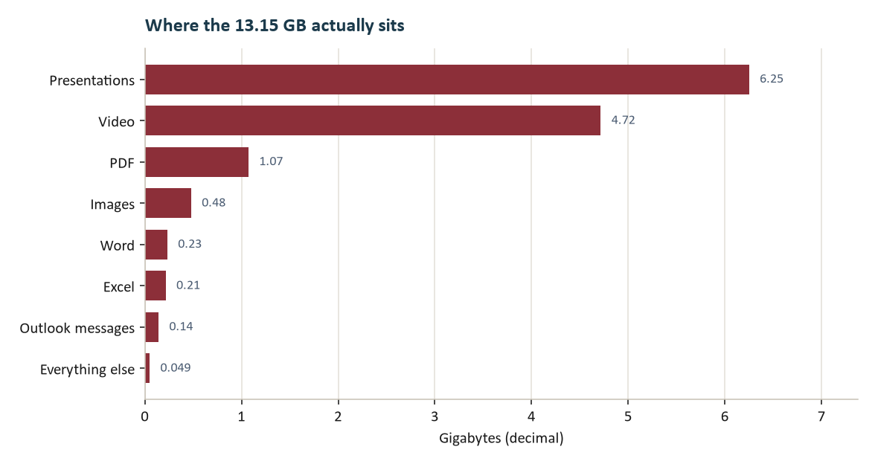
Figure 1. Unpacked size by file type. Presentations combine PowerPoint files. Video combines MP4 and MOV.
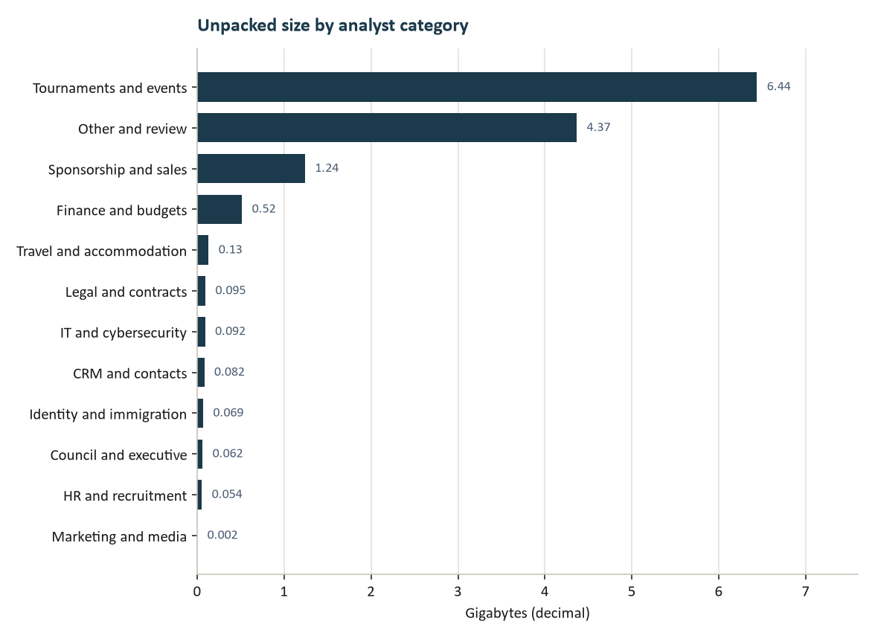
Figure 2. Unpacked size after the analyst sort. Marketing is 2 MB and rounds to 0.002 GB. Identity and immigration, the highest-harm category, is 0.07 GB.
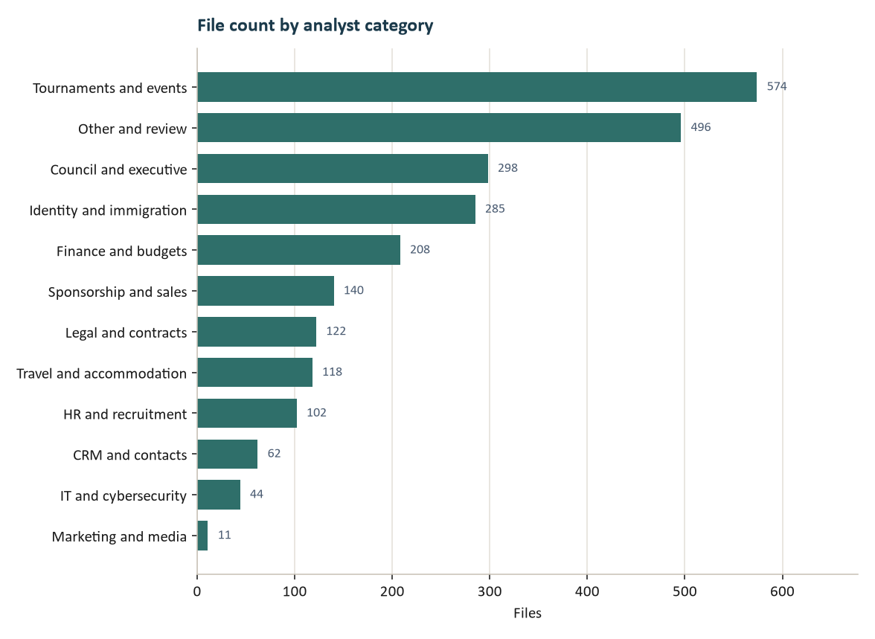
Figure 3. File counts. Identity (285) and council material (298) are large by count and small by size. That is the shape of scanned documents and short spreadsheets.
The practical consequence: a volume comparison with other leaks will overstate this one if it is treated as 13 GB of records, and it will understate it if the identity files are dismissed because they are small. The pages that can be misused are the scans, the tickets, the council calendar, the negotiation sheets, and the dashboard captures.
| Category | Files | GB | Tier | What drives the tier |
| Tournaments and events | 574 | 6.44 | Mixed | Video and decks, plus live Qatar workforce papers and guest trackers |
| Other and review | 496 | 4.37 | Mixed | Residual bucket: partner decks, a customer dashboard, negotiation sheets |
| Sponsorship and sales | 140 | 1.24 | High | Pitch material and commercial training |
| Finance and budgets | 208 | 0.52 | High | Revenue workbooks and a customer-revenue dashboard |
| Travel and accommodation | 118 | 0.13 | Critical | Tickets, hotels, and parties travelling together |
| Legal and contracts | 122 | 0.09 | High | Mandates, invoices, freelancer packs that request a passport |
| IT and cybersecurity | 44 | 0.09 | Medium | Policies and architecture; a few how-to passwords sit outside this folder |
| CRM and contacts | 62 | 0.08 | High | Mailing lists and prospect lists; how-to guides with passwords |
| Identity and immigration | 285 | 0.07 | Critical | 169 passport-titled files and 116 visa-titled files |
| Council and executive | 298 | 0.06 | Critical | Meeting 37 and 38 logistics, including a November–December 2026 plan |
| HR and recruitment | 102 | 0.05 | High | Holiday tracker, interviews, CVs |
| Marketing and media | 11 | 0.002 | Lower | Small set, including a logo |
Table 1. Categories are the analyst sort. Tiers are this paper’s judgment, not the sorter’s score.
6. Evidence that the material is genuine
Authenticity here means two different things, and only one of them is established. The documents are real FIFA operational documents. The path by which they left FIFA — a FIFA tenant, a contractor’s laptop, a protocol officer’s OneDrive — is not established.
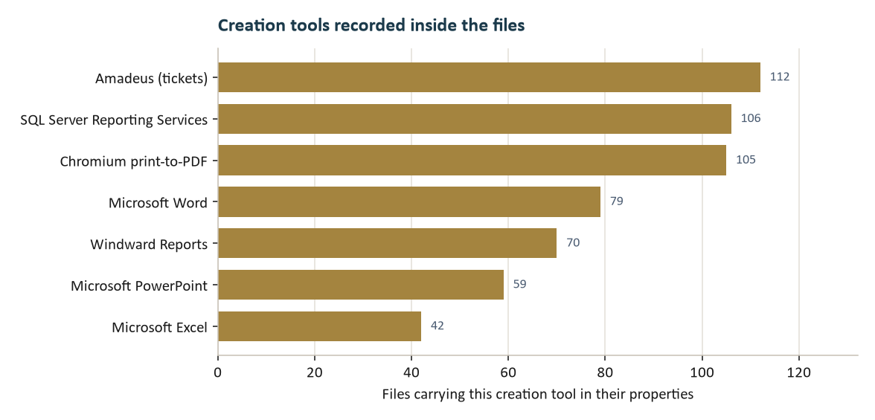
Figure 4. Creation tools written into file properties. The counts overlap and are not a partition of the 2,460 files. Excel is one locale string; a second Excel locale string appears on further files and is not added.
One hundred and twelve PDFs were produced by Amadeus, the airline reservation system. Those are electronic tickets, not files renamed to look like tickets. One hundred and six were rendered by Microsoft SQL Server Reporting Services, which is an internal report export. About a hundred were printed to PDF from Chromium. Seventy carry Windward Reports, a document-generation tool, as author. Word, PowerPoint, and Excel for Microsoft 365 account for further large groups. Contracts that were opened use FIFA’s Zurich address, FIFA-Strasse 20, 8044 Zurich, and Swiss law.
A screenshot of a Windows “About” box shows Windows 10 Enterprise, version 1809, build 17763, with the licensee lines reading FIFA. That build has been out of support for years. It proves a FIFA-licensed PC was screenshotted. It does not describe the current estate. A second storage screenshot of the same machine is omitted here because the volume label may be a personal name.
Contact data, in the sampled cells, contains at least 3,130 email addresses. Of those, 1,534 are at fifa.org. Further organisational domains in the same sample include fwc2026.org (147), fifamuseum.org (83), fwwc2027.org (47), and confederation domains for CONMEBOL, CONCACAF, the AFC, UEFA, and the German football association. Fourteen addresses are at mos.gov.sa, the Saudi Ministry of Sport. Personal webmail is mixed in, including 97 gmail.com addresses in the sample. Commercial domains in the same sample include a data-software firm, a carmaker, a sports-merchandise firm, and several consumer brands. That mix is a sales and protocol address book. It is what a FIFA commercial team would have on hand.
What would still be true if a supplier, rather than a Zurich server, were the source: the documents are FIFA’s, the scans are of people dealing with FIFA, and the publication is FIFA’s problem. The (Freelancer) and (FIFA26) author tags, and invoices addressed to FIFA, show the library already mixed staff, contractors, and vendors before it was copied. A supply-chain reading remains open. A hoax reading does not. Empty decoy filenames would not carry Amadeus ticket producers, Reporting Services renderers, and a shared Microsoft correlation identifier.
7. What the documents show
7.1 Identity documents
The identity category is 285 files, 69 MB, and every file opened. One hundred and sixty-nine are titled as passports and 116 as visas. Two hundred and two are colour JPEGs, all of them ordinary RGB photographs, with a median size of about 0.7 megapixels, which is the range of a photographed or scanned document rather than an icon. Eighty-three are PDFs, and 79 of those PDFs are a single page. Filename stems are almost all distinct. That is not a headcount. A passport and a visa for the same person are often saved under different titles, so the number of people is lower than 285 and is not pinned down here. It is plainly a large set, on the order of well over a hundred people.
One hundred and twenty-eight of the filenames also contain an email address. Courtesy titles appear on some of them, including HE and, in one case, HRH. That HRH file is named for Prince Abdulaziz bin Turki Al Saud, the Saudi Minister of Sport, who is a public official. His document is not shown, and no document number is recorded in this paper. He is named once so the seniority is concrete. The rest of the set is not listed. Contact data at mos.gov.sa, in the spreadsheets, fits a ministry delegation travelling with its staff, alongside council members from many confederations. Those are different groups, filed for the same operational reason: someone at FIFA had to move them across a border.
A second, independent reason the scans exist is in the legal folder. A freelancer contract pack instructs the person to attach a copy of their passport. The pack is a real FIFA template, filled in, with a day rate of USD 185 and World Cup 2026 budget codes. The freelancer’s name and the signature-envelope identifier are omitted. Staff and contractor onboarding, and VIP travel, are both feeding the same folder of scans.
7.2 Council, tickets, and hotels
Sixty-four files refer to FIFA Council meeting no. 37, and three refer to meeting no. 38. Three files are private-jet manifests for meeting 37. Another is a rail booking between Geneva and Zurich. Hotel confirmations and electronic tickets include people travelling in the same party. A council tracker, kept by a freelancer author tag, has columns for the envoy, the team, the status, and a messaging-app handle. A mailing list workbook was last modified on 18 May 2026. A November–December 2026 council workbook was modified on 11 November 2026. A December 2026 standing-committee matrix has columns for date, time in CET, the committee in three languages, and the council delegate. An attendance sheet for meeting 37 carries a 12 October label.
World Cup guest material is a parallel set. There is a flight matrix, a hotels workbook with brand, peak inventory, contract status, and rates, and per-delegate day plans with columns for flight number, take-off, arrival, and cost. A consolidated guest tracker has columns for brand, name, role, and email, and was modified on 10 November 2026. Individual trackers exist for specific officials and list venue, accommodation, and who attended which match.
The World Cup itself, played in June and July 2026, is over as of this review. A guest itinerary in the set runs from 9 June into Mexico through a 20 July return. That class of booking is now historical, and the identity document underneath it is not: a passport outlives the match. The November and December 2026 council and committee files were edited on 11 November. On 23 November, part of that calendar is still ahead. This paper does not print the dates, cities, flight numbers, or hotel names from those sheets.
7.3 The Qatar workforce pack
A separate tournament is current in the files. Workforce service levels for the FIFA U-17 World Cup Qatar 2026 say they take effect on 5 November 2026 for FIFA staff and freelancers on the tournament team in Qatar, and they cover flights and visas. An accreditation collection notice and a clean-site guide for partnership rights sit beside them. A one-page wireless guide, dated 8 November 2026 and marked Public on its face, gives the event network name and a password. The password and the network name are withheld. A public marking on a how-to does not make a live venue password harmless while the tournament workforce is using it.
7.4 Money, sponsors, and the customer dashboard
Two screenshots are captures of the same internal dashboard, one on a demographic view and one on an email view. The headline tiles agree. Registered customers: 106.0 million. Ticket revenue, all tournaments: $1.9 billion. Hospitality revenue, all events: $343.3 million. Store revenue: $20.6 million. Collect revenue: $41.9 million. Museum revenue: $14.8 million. The email view shows about 50.8 million people, 48 percent, opted in to FIFA email, and about 39.5 million opted in to partner email, with send, open, and click counts on the same screen. The activity control runs up to 18 November 2026.
These tiles are what an internal business-intelligence screen displayed. They are not an audited financial statement, and they are not in this archive as rows. Every CSV in the tree together is under one megabyte. A 106-million-person table is not here. What is here is the picture FIFA’s own commercial staff could see: scale, revenue mix, and email performance. That picture is not the sort of figure FIFA puts in a statutory report at this granularity. It is new relative to the public write-ups, which could see filenames such as “revenue” and could not see the numbers.
The workbooks behind the commercial team are more specific than the tiles. A World Cup 2026 revenue master has sheets for a level-1 summary, a level-2 summary, and a contract view with columns for revenue stream, sold-to party, contracted, potentials, and forecast. A last-slots projection, modified 6 October 2026, has an in-tournament new-revenue sheet. Older forecast workbooks go back several years, including a 2020 corona-risk revenue model and a February 2022 forecast. A 2024 partnership-sales budget file includes actuals with cost centre, cost element, and posting date. The cell values of those sheets are not copied into this paper. The structure is enough to show unpublished forecast and actuals material, not a blank template.
Negotiation tables are the clearest commercial harm. A DoorDash table dated 4 November 2025 has columns for the issue, DoorDash’s position, FIFA’s position, the required outcome, and extra commercial and legal flexibility. A Doc.com table dated 8 April 2026 sets FIFA’s proposals next to the other side’s offer. A DoorDash territory tracker has a column for World Cup 2026 revenue allocated. A file titled Crypto Hit List, dated 20 April 2026, is a sales target list: company, contact name, title, email, the FIFA account executive, and a status. It is not a cryptocurrency theft. Prospect lists for Nashville, Miami, and a champions-cup event sit in the same commercial working set.
Filenames of large decks name Cisco, Amazon, Unilever, Novartis, Hisense, Intuit, Deloitte, and Fanatics, and they also name Betsson and 1Win. Slide text was not extracted. A filename establishes that a deck about that company was in the library. It does not establish a signed sponsorship. FrenchBreaches was right to warn that a brand name in a FIFA folder is not a breach of that brand.
Two small contracts show the grain of the legal folder. A mandate with Re Worldwide Ltd of London, for customising a sponsorship sales presentation, is capped at USD 40,721.94 before tax. An invoice from Vienna Consulting in Prague, dated 23 December 2025, bills EUR 9,878 for presentation design and is addressed to FIFA in Zurich. The invoice carries the supplier’s bank coordinates. They are not copied.
7.5 IT papers
The IT category is 44 files and 92 MB, and it is mostly what FrenchBreaches hoped it was not: policy and template, rather than a vault of administrator passwords. The password management policy is version 1.1, dated 10 November 2022. It says failure to follow it can cost confidentiality, integrity, and availability, that it binds employees, contingent workers, and contractors, and that exceptions need a risk acceptance and compensating controls agreed with IT security. Violations go to the Data Protection and Cybersecurity Risk team. The numeric rules inside it are not repeated here, because they are exactly the sort of detail that helps a password guess.
A vulnerability management policy and a patch-management requirements paper are both marked Internal and both dated 19 July 2023, authorised in the name of the same cybersecurity function. The vulnerability policy’s opening description speaks about cryptographic algorithms, while its title and revision history speak about vulnerability handling. That mismatch is in the file. It is a drafting error, and it is also evidence the file is an internal draft history rather than a public brochure.
Azure deployment guidelines, version 1.2, were modified on 25 June 2025. They are written for vendors who will host applications in FIFA’s Azure tenant. They state that every product gets three subscriptions, and they cover naming, security constraints, and preferred services. The naming strings and any subscription identifiers are not copied. A cloud reliability guide dated 27 August 2025 covers both AWS and Azure. For workloads it classes as high criticality it names three examples: the Secutix ticketing solution, the football tournament app, and FIFA.com. It names Akamai for global load balancing and failover. For that tier it describes recovery in minutes and data loss near zero. The service-by-service recipe under that heading is not copied. Knowing which three systems FIFA’s own guide calls mission-critical is the useful part, for a defender and for an intruder.
A technology vendor framework of March 2025 defines a tier of strategic vendors and a tier of key vendors and platforms, and it includes negotiation guidance. A major-incident report template and architecture principles from 2020 are blank structure and general rules. An enterprise-architecture note from 2020 describes a move toward publish-and-subscribe integration and microservices. None of that is a network diagram with live host names in the pages that were read.
Secret-pattern search across the sampled text found no private keys and no database connection strings. It found password assignments in three guides titled as instructions for adding event contacts, and in the Qatar wireless guide already described. Those four documents are the credential problem in this collection. The password policy is not.
7.6 Staff and hiring
A 2026 holiday tracker was modified on 11 November 2026. Interview schedules exist for spring 2025 and March 2026. Files titled as CVs are present; their contents were not transcribed. Combined with the freelancer pack and its request for a passport, the HR folder is a ordinary personnel working set, which is enough to create a privacy duty toward staff and applicants.
8. What this adds to the public record
The press on 21 and 22 November could see a claim, and in one case a screenshot of a file tree. It could not open the files. These points were not in that reporting.
- The unpacked collection is 2,460 files and 13.15 GB. About 83 percent of the bytes are presentations and video. Identity documents are 69 MB.
- Exact duplicates add 1.6 percent, not a second copy of the archive. A small number of office files are damaged. Thirty further files never downloaded and survive only as Microsoft error slips.
- Those slips share one correlation identifier and are timestamped 12 November 2026 at 00:00 UTC, nine days before the forum post.
- The identity set is 169 passport-titled files and 116 visa-titled files. All of them opened as real images or one-page PDFs. The number of distinct people was not resolved, and the names are withheld apart from one public office.
- The 106.0 million customer figure, and the revenue tiles around it, are a dashboard screenshot. The customer table is not in the archive.
- Passwords are present in a venue wireless guide and in three event-contact how-to guides. They are not present as a dump inside the password policy. No private key and no database connection string turned up in the sampled text.
- Council and standing-committee planning files were modified on 11 November 2026 and cover meetings still ahead of 23 November. Three private-jet manifests are in the meeting 37 set.
- The Qatar U-17 workforce pack took effect on 5 November 2026. It is current operational material, including accreditation and visas.
- Negotiation tables record both sides’ positions with DoorDash and with Doc.com. A “crypto” workbook is a sales prospect list.
- An internal reliability guide names Secutix ticketing, the football tournament app, and FIFA.com as high-criticality examples, and names Akamai plus AWS and Azure.
- Freelancer onboarding asks the person to attach a passport. That is one concrete reason the scans exist, alongside VIP and council travel.
- There is no ransom note and no mass of encrypted files. The extortion, if the demand is real, is publication. Ransomware deployment is not shown.
9. How critical it is
Criticality is scored for harm that is available now, from this collection, to someone who already has the files. It is not a score for how skilled the publisher is, and it is not a prediction that every file will be abused.
| Area | Rating | Basis |
| Passport and visa images | Critical | Long-lived government identity documents, in image and one-page PDF form, for a large set of travellers and officials. |
| Council movements still ahead, private-jet manifests, family travel | Critical | November and December 2026 planning was edited on 11 November. Historical World Cup travel remains sensitive because the identity document remains valid. |
| Qatar workforce pack and venue wireless password | High | Instructions effective 5 November 2026, for people on the ground. The password is live operational access for as long as it is unchanged. |
| Negotiation tables, revenue forecasts, hotel rates | High | Unpublished commercial position, including the other party’s stance. |
| Customer dashboard | High | Scale, revenue mix, and email performance of a 106-million-profile base. The profiles themselves are not in the files. |
| Mailing and prospect lists | High | At least 3,130 addresses in a partial read, dominated by fifa.org, with personal webmail included. |
| IT policies and the reliability guide | Medium | A map of priorities and standards. Useful to a later intruder. Not a credential vault, apart from the four how-to documents scored above. |
| Training video, logo, public-style schedules | Lower | Most of the gigabytes. Internal, and low value compared with the scans. |
Table 2. Ratings apply to this collection as published. They assume the files are already in other people’s hands, which is what a forum post means.
Taken together, the incident is a high-severity privacy and commercial breach with a current physical-security edge around council travel and the Qatar tournament. It is not a competition-integrity incident. Nothing examined is a live scoring path, a stream key, or a match-official channel. The June 2026 access-control failure was that kind of event. Conflating the two would misstate both.
10. Who can be harmed
People in the identity files
A passport or visa image is enough, in the wrong hands, for impersonation at a border, for an account-recovery flow that asks for a document photo, and for a forged supporting document. The harm lasts until the document expires or is replaced, which is years, not the length of a tournament. The set includes a serving sports minister and other people addressed as HE, and it includes many people with no public role. Family members appear on hotel and ticket filenames travelling with an official. They carry the same document risk and a smaller public profile, which makes them easier to overlook in a notification programme. Names are withheld here so this paper does not become the index.
Officials with movements still on the calendar
A council workbook and a December committee matrix describe who is expected where, and a tracker stores a messaging-app handle next to the envoy. Someone building a lure only has to quote a real meeting. Someone meaning physical harm has a narrower window: the November and December 2026 meetings, the private-jet manifests from meeting 37, and any delegate still in transit. World Cup guest movements in June and July are in the past. The habit of filing full day plans, flight numbers, and costs in the same sheet is what will make the next tournament’s file just as sensitive.
The Qatar tournament workforce
Staff and freelancers covered by the 5 November service levels are in the middle of travel, visas, and accreditation. A wireless password for the event network is a practical harm for the days the network still uses it: anyone on site, or near it, can attempt to join. Accreditation procedures tell an outsider how collection works. This is workforce safety and event operations, not a youth-player identity set. The identity folder was not a roster of under-17 players.
FIFA as an institution
The publication is an extortion prop whether or not a ransom was paid. Reputational harm is already available to anyone who has the forum post. Regulatory exposure follows the people, not the logo. FIFA is established in Switzerland, so the Federal Act on Data Protection is the home regime. Council members, European vendors, and European staff pull the same files into the GDPR. The freelancer packs, the holiday tracker, and the passport scans are personal data in the strict sense. The dashboard is personal data in aggregate form even though the rows are absent.
Commercial counterparties
DoorDash and Doc.com did not, on this evidence, have their own networks breached. What left is FIFA’s record of their negotiating position, and FIFA’s. Hotels in the rate workbook are in the same position: inventory and rate, seen from FIFA’s side. Prospects on the sales lists, including the crypto target list, have had a business contact and a status exposed. Brands named on deck titles have had the existence of a FIFA conversation exposed, which is a smaller fact. Notifying the counterparties whose positions are in the tables is a different action from notifying every logo in a filename.
Staff, freelancers, and applicants
Holiday patterns, interview schedules, a day rate, and CVs are ordinary employment data and still personal. The onboarding instruction to attach a passport means some of the identity files may be workers rather than VIPs. A notification that only covers council members will miss them.
Fans and customers
The dashboard describes 106 million registered customers by revenue and, on the email view, by consent and engagement. It does not hand over those customers one by one. The harm to fans from this collection is indirect: a confidential picture of them exists outside FIFA, and the architecture guide tells a reader which customer-facing systems FIFA itself ranks as mission-critical. That is a lead for a later attack. It is not this attack.
Match integrity and the public
Spectators, broadcasters, and competing teams are not shown to be exposed through a manipulated result or a stolen live feed. The public interest in this collection is the privacy of the people in it, and the governance of a body that files their passports next to its commercial pipeline.
11. Samples
Three artefacts are reproduced because they show the character of the publication without adding document numbers, bank details, or passwords. Identity images are described and not shown.
The forum post
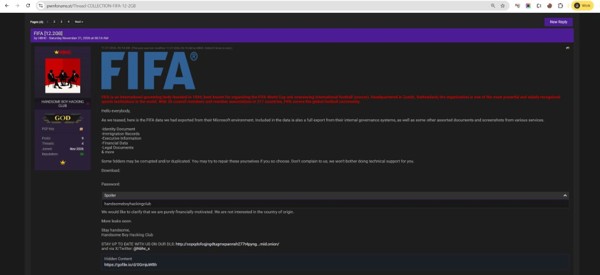
Figure 5. The clearnet post of 21 November 2026, 06:14, offering the collection. The archive password and the download address have been left in the captured page and are not transcribed in this paper.
The post is the publisher’s account of motive and scope. The file review agrees with the Microsoft claim, agrees that identity, immigration, executive, financial, and legal material is present, and agrees that some files are damaged or duplicated. It does not agree that the result is a full export of internal governance systems.
The customer dashboard
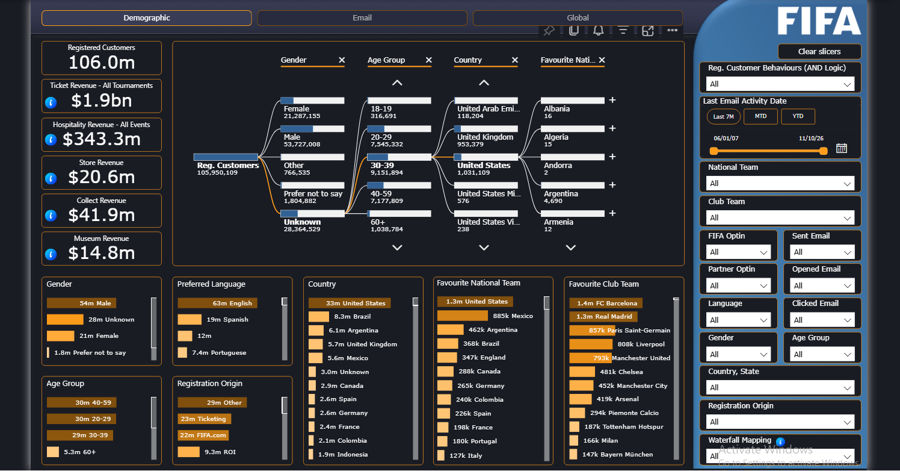
Figure 6. Internal dashboard, demographic view. Headline tiles match the email view in Figure 7. Read the tiles as a screen capture, not as audited accounts. Demographic bars are filter-sensitive and are not transcribed as a census.
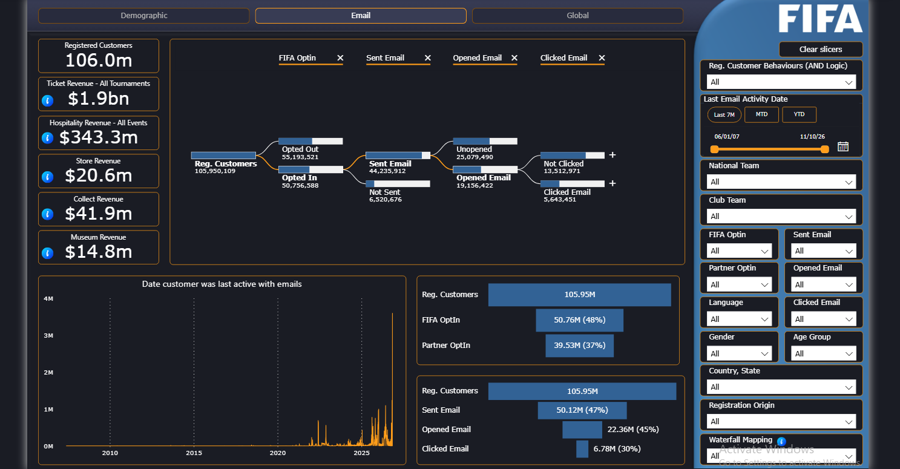
Figure 7. The same dashboard, email view. Opt-in, send, open, and click figures are visible. The underlying customer table is not in the collection; all CSV files together are under 1 MB.
What an internal policy looks like
“This password management policy defines rules for strong password practices to enhance information system security of FIFA’s systems and data.” The document is version 1.1, dated 10 November 2022, and it binds personnel and contractors. The rule values themselves are not quoted.
That excerpt is the right sample of the IT folder: a real internal policy, marked by its own header as binding, and useless as a list of current passwords. The contrasting sample is the Qatar wireless guide, which is one page, marked Public, dated 8 November 2026, and does contain a password. Reproducing it would be the harm.
What the identity set looks like, without the images
| Measure | Result |
| Files in the identity category | 285 |
| Titled as a passport | 169 |
| Titled as a visa | 116 |
| Opened successfully | 285 of 285 |
| Colour document photographs | 202 |
| Single-page PDFs | 79 of 83 PDFs |
| Filenames that also contain an email address | 128 |
| Images reproduced in this paper | 0 |
Table 3. The identity category, counted and not displayed.
What a contract sample looks like, without the bank line
The Vienna Consulting invoice of 23 December 2025 is a tax document for presentation-design services, total EUR 9,878, reverse charge, addressed to the Fédération Internationale de Football Association at FIFA-Strasse 20, 8044 Zurich. A mandate with Re Worldwide Ltd caps a related design engagement at USD 40,721.94 before tax. Both documents are real commercial paper. The supplier bank account on the invoice is the line that does not belong in a circulated copy, and it is omitted.
12. Limits
- This is the unpacked, sorted copy. It was not checksum-matched to a publisher file, because no checksum was published. The local RAR is 11.78 GB and the tree is 13.15 GB.
- PowerPoint bodies were not read. A deck title is not the deck.
- Videos were not watched. They dominate the size and may contain spoken personal data this paper does not capture.
- Outlook message bodies were not transcribed. Filenames show tickets and hotel confirmations; the bodies may hold further itinerary detail.
- Passports were not OCR’d. Nationality, expiry, and document numbers were deliberately not extracted.
- The email count is a floor from CSV files and the first 40 rows of each workbook.
- No FIFA public statement was found as of 23 November 2026. The account that performed the 12 November download is not identified.
- Category tiers are a judgment on harm. The sorter’s own numeric scores were not used.
13. Sources
Files. The sorted collection and its sorting log, reviewed 23 November 2026. Original paths show a nested folder tree. Counts, hashes, document properties, and the redacted reads described in section 3.
The publication. Clearnet forum post by the group, 21 November 2026, 06:14, thread presented as a 12.2 GB FIFA collection. Figure 5.
Contemporaneous reporting. Escudo Digital, Alberto Payo, “New cybercrime group threatens FIFA with data leak over ransom,” 21 November 2026, 06:15. FrenchBreaches, “La FIFA visée par une fuite massive,” 21 November 2026, updated 09:46. Security-incidents.de, FIFA incident note, November 2026. IPCRIME ransomware-watch record, 22 November 2026. ransomware.live group page for the same name, consulted 23 November 2026. DeXpose and tracker pages were used only for the listing time and the quoted threat text, and they disagree with each other on detail; the file review was preferred wherever they conflict.
Separate 2026 events, cited so they are not merged into this one. TechCrunch, 16 June 2026; iTnews, 17 June 2026; Dark Reading, 18 June 2026, on the Entra access-control failure. UCHealth, “UCHealth Notifies Individuals of Data Security Incident,” 13 November 2026.
Prepared 23 November 2026. Distribution: internal. The raw collection remains the sensitive object. This document is the reading of it.