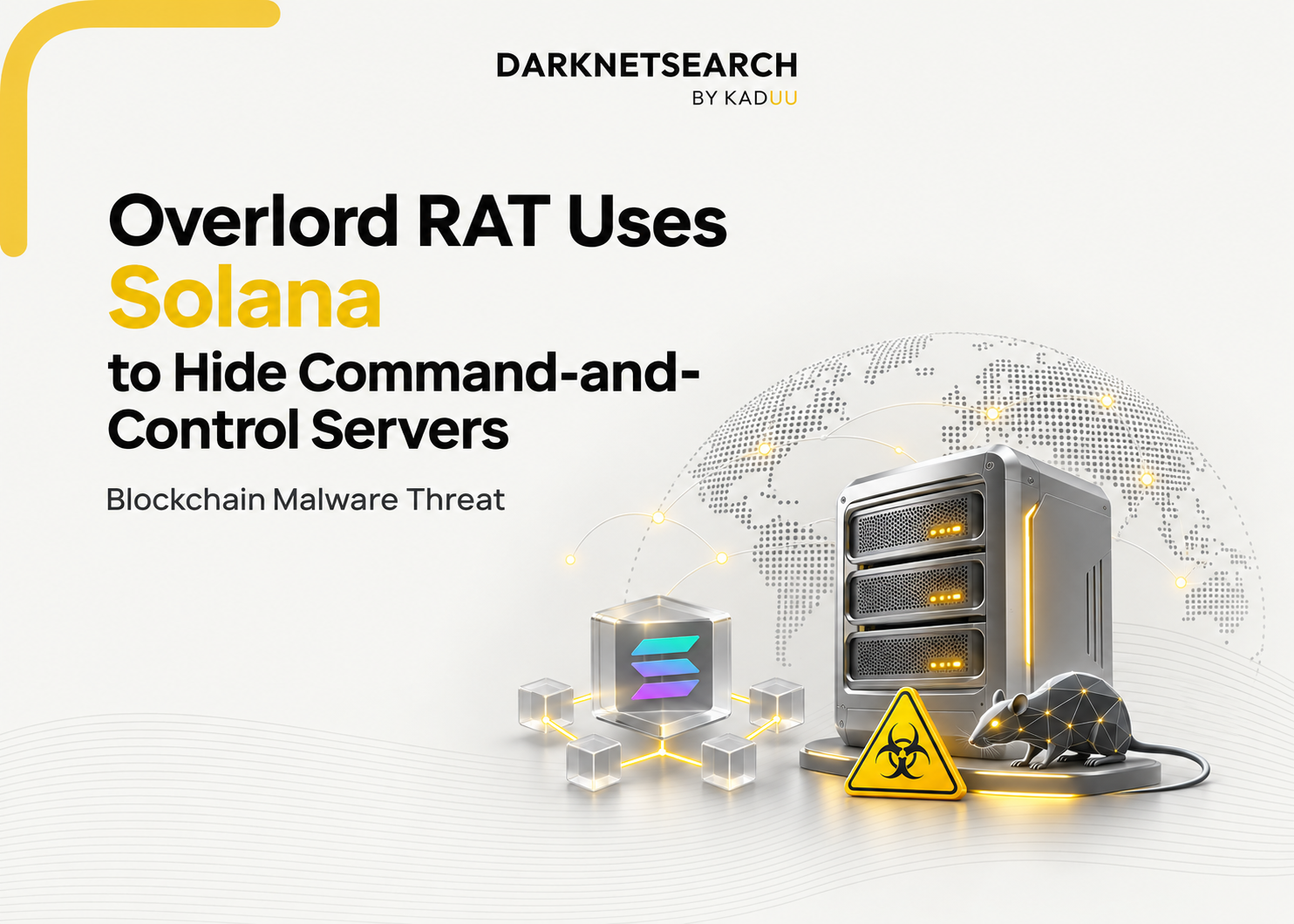
Overlord RAT is drawing renewed attention to the growing misuse of public blockchains for malware operations. According to research published by Cisco Talos on November 18, 2026, a financially motivated threat actor tracked as UAT-12643 has used Solana blockchain transactions to conceal command-and-control (C2) server addresses. The discovery highlights why organizations increasingly need to combine endpoint security with dark web and cybercriminal activity monitoring to understand the broader threat landscape.
The technique is particularly concerning because attackers can use legitimate blockchain infrastructure to distribute configuration information without relying entirely on conventional domains or centralized servers.
Cisco Talos assesses with low confidence that UAT-12643 may be aligned with North Korean threat actors. This possible connection remains an analytical assessment rather than confirmed attribution.
For security teams, the important question is how decentralized infrastructure changes malware detection, incident response, and cyber threat intelligence.
What Is Overlord RAT?
Overlord RAT is a modular remote access trojan targeting Windows systems. The variant examined by Cisco Talos is written in Go and enables attackers to maintain unauthorized access to infected devices.
Remote access trojans can provide cybercriminals with capabilities such as executing commands, retrieving information, and communicating with attacker-controlled infrastructure.
What makes this particular campaign noteworthy is its method for locating that infrastructure.
Instead of depending exclusively on a server address stored inside the malware, Overlord RAT can retrieve encrypted C2 configuration information from Solana blockchain transactions.
This creates an additional layer of resilience.
If defenders discover and block a malicious server, attackers may update the blockchain-based reference without distributing a completely new malware executable.
The technique demonstrates how legitimate decentralized technologies can be repurposed for malicious operations.
How Overlord RAT Uses the Solana Blockchain
Solana is a public blockchain designed to process transactions efficiently.
One of its capabilities is the Memo Program, which allows additional information to be attached to transactions.
Although this feature serves legitimate purposes, threat actors can misuse it to store information that infected machines later retrieve.
Blockchain transactions as hidden communication references
In the campaign analyzed by Cisco Talos, attackers placed encrypted server URLs inside Solana transaction memos.
The malicious software could retrieve the stored information, decode the destination, and establish communication with its C2 infrastructure.
The process can be summarized in four stages:
- The attacker publishes encrypted configuration information within a Solana transaction memo.
- The malware queries the blockchain through accessible infrastructure.
- The relevant information is retrieved and decrypted.
- The malware uses the recovered destination to contact the attacker-controlled server.
The blockchain is not necessarily carrying the malicious commands themselves. Its role in this case is primarily to provide a resilient mechanism for discovering the infrastructure used for subsequent communication.
This distinction matters because the technique does not mean that Solana itself has been compromised.
Instead, attackers are abusing legitimate functionality available to anyone using the network.
Why blockchain-based C2 is difficult to disrupt
Traditional malware investigations frequently identify malicious domains, IP addresses, and hosting providers.
Security teams may then block network connections or coordinate infrastructure takedowns.
Blockchain-based configuration storage complicates that approach.
Because transaction records are distributed across a decentralized network, removing a particular reference can be considerably more difficult than disabling a conventional server.
Furthermore, queries to blockchain infrastructure may resemble legitimate application traffic.
This creates a detection challenge for organizations that depend primarily on static indicators of compromise.
Who Is Behind the Overlord RAT Campaign?
Cisco Talos tracks the activity as UAT-12643, describing it as a financially motivated threat cluster.
The researchers identified several malicious tools associated with its operations, including Overlord RAT, a Python-based information stealer referred to as Good Game, and a clipboard hijacker targeting cryptocurrency activity.
The observed malware and lure-file characteristics suggest potential interest in cryptocurrency holders, gaming platform users, VoIP software users, and finance-related personnel.
Researchers also identified functionality designed to search for files containing particular keywords in English, French, Spanish, and Portuguese.
This suggests potential interest in European victims, although the research does not establish a complete list of affected organizations or confirmed geographical distribution.
Is UAT-12643 connected to North Korea?
Talos identified similarities between the group’s techniques and those previously associated with North Korean threat actors.
However, the researchers explicitly assigned low confidence to this attribution.
Overlord RAT and related blockchain techniques have also appeared in activity involving other threat actors.
Consequently, describing the campaign as definitively conducted by North Korea would overstate the available evidence.
The distinction between technical observations and intelligence assessments is essential for responsible cybersecurity reporting.
How the Malware Reaches Potential Victims
The investigation identified several suspicious execution mechanisms involving Windows shortcut files, HTML Application files, and XML-based execution techniques.
Some malicious shortcuts imitated ordinary documents or legitimate Windows components.
The campaign also used familiar Windows utilities to retrieve and execute payloads, helping malicious activity blend into normal system operations.
These techniques illustrate how attackers exploit trust in familiar file formats and legitimate software components.
However, Talos did not establish the precise method used to deliver the initial malicious files to victims.
Security teams should therefore avoid assuming that one specific phishing campaign or delivery channel was responsible for every observed infection.
Why security awareness still matters
Employees may encounter malicious files disguised as financial documents, software installers, or routine business communications.
A realistic security awareness training program can help users recognize suspicious requests, verify file origins, and avoid executing unexpected content.
Organizations should also monitor look-alike domains and impersonation attempts using appropriate domain monitoring and brand protection tools.
These measures address related social engineering and impersonation risks. They do not directly detect blockchain-based command-and-control activity.
Effective protection requires combining human awareness with endpoint, network, and identity security controls.
Why Overlord RAT Matters for Cyber Threat Intelligence
The campaign highlights a broader evolution in the methods used by sophisticated malware operators.
Attackers increasingly combine legitimate infrastructure with malicious objectives.
Public blockchain networks, cloud services, file-sharing platforms, and trusted system utilities can all become components of an attack chain.
This creates challenges for security operations centers that depend heavily on known malicious infrastructure.
A domain or IP address may remain useful as an indicator, but blocking it does not necessarily eliminate the underlying malicious capability.
Security teams need additional context about attacker behavior, malware families, campaign infrastructure, and potentially exposed organizational assets.
DarknetSearch has previously examined related North Korean threat activity in its analysis of malicious npm packages and dark web exposure risks.
Although the techniques differ, both cases demonstrate how compromised systems can expose valuable information and create opportunities for further intrusion.
Connecting malware investigations with external exposure
An infection involving an information stealer may create risks extending beyond the initially compromised device.
Depending on the malware’s capabilities and the information accessible to it, attackers may obtain passwords, authentication tokens, sensitive files, or financial information.
Stolen information can subsequently be reused, exchanged, or advertised through underground communities.
However, there is no verified evidence that information stolen specifically through this UAT-12643 campaign has appeared in dark web marketplaces.
Monitoring external sources can provide useful complementary intelligence when relevant exposure becomes observable.
It cannot establish the absence of a breach or replace direct technical investigation.
How Organizations Can Detect and Respond to Blockchain-Based Malware
Defending against this activity requires a layered security approach.
Monitor unusual endpoint behavior.
Investigate unexpected execution of Windows utilities, suspicious shortcut files, unusual child processes, and unauthorized payload downloads.
Review blockchain-related network activity.
Organizations that do not normally use blockchain applications should investigate unexpected requests to public blockchain RPC services.
Where blockchain access is legitimate, establish behavioral baselines rather than indiscriminately blocking all related traffic.
Correlate network and endpoint telemetry.
Unusual blockchain queries become more meaningful when associated with suspicious processes, unexpected persistence mechanisms, or connections to unknown infrastructure.
Protect sensitive credentials.
Apply phishing-resistant multifactor authentication where possible, restrict privileges, and revoke exposed authentication tokens when compromise is suspected.
Use current threat intelligence.
Review indicators and detection guidance from the original Cisco Talos investigation of UAT-12643.
Maintain incident response readiness.
If Overlord RAT is suspected, isolate affected systems when appropriate, preserve forensic evidence, investigate persistence, and assess whether sensitive information was accessed or exfiltrated.
The objective is to identify malicious behavior rather than relying exclusively on infrastructure blocklists.
Frequently Asked Questions
What is Overlord RAT?
Overlord RAT is a Windows remote access trojan that can enable unauthorized communication between an infected device and attacker-controlled infrastructure. The variant analyzed by Cisco Talos uses encrypted information stored in Solana transaction memos to locate its command-and-control servers.
Does Overlord RAT mean the Solana blockchain has been hacked?
No. The reported technique exploits legitimate transaction functionality rather than a demonstrated vulnerability in Solana itself. Attackers use blockchain records as a location for encrypted configuration information that malware can retrieve.
Is Overlord RAT definitely operated by North Korean hackers?
No. Cisco Talos assesses with low confidence that the UAT-12643 threat cluster may be aligned with North Korean actors. Similar malware and blockchain techniques have been associated with other threat activity, so attribution remains uncertain.
Can dark web monitoring detect an Overlord RAT infection?
Dark web monitoring cannot reliably determine whether a device is infected with Overlord RAT. Endpoint detection, forensic analysis, and network telemetry are more appropriate for that purpose. External threat intelligence may help identify related credential exposure, suspicious discussions, or compromised organizational information if such evidence appears in monitored sources.
Strengthen Visibility Beyond the Corporate Network
The Overlord RAT investigation demonstrates why defending an organization increasingly requires understanding both internal attacks and external threat exposure.
As attackers experiment with decentralized infrastructure, security teams need to combine behavioral detection, incident response, credential protection, and relevant cyber threat intelligence.
DarknetSearch helps organizations investigate leaked credentials, exposed corporate information, and threats identified across monitored external sources. Its capabilities complement endpoint and network security rather than replacing them.
Explore how DarknetSearch’s free trial and live demo can help your security team understand external exposure, investigate relevant threat intelligence, and strengthen its overall cybersecurity posture.