Korean Air data breach revealed: Key facts about employee exposure

➤Summary
The Korean Air data breach has raised urgent concerns across the aviation and cybersecurity sectors after reports confirmed that sensitive employee information was exposed through a third-party compromise. According to multiple security disclosures, the incident affected thousands of workers and stemmed from vulnerabilities tied to an external service provider rather than Korean Air’s core systems.
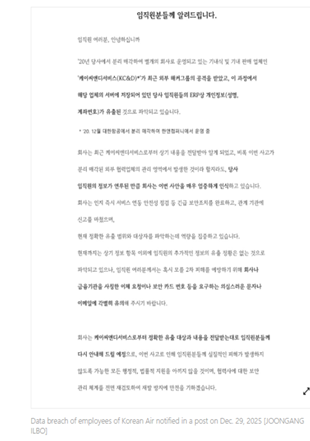
This employee data breach highlights how supply chain risks continue to challenge even the most security-aware enterprises ✈️.

What Happened in the Korean Air Data Breach
Investigations revealed that the Korean Air data breach originated from a compromise involving a third-party supplier that used Oracle-based systems. Attackers took advantage of security gaps within a third-party supplier, gaining unauthorized access to employee-related information. Korean Air stated that flight operations and passenger booking platforms remained unaffected, but internal staff data was exposed. According to local media, the incident traces back to the airline’s catering and duty-free unit, which was using Oracle E-Business Suite while a critical flaw, identified as CVE-2025-61882, was being actively abused. Such employee data breach incidents are becoming more frequent, as threat actors increasingly target supply-chain environments instead of well-protected core systems ⚠️
Compromised Data: What Information Was Exposed
So, what data was actually compromised? Reports indicate that the exposed information included:
- Employee full names
- Corporate email addresses
- Phone numbers
- Employee identification numbers
- Job roles and department details
Importantly, there is no evidence that financial data or passenger information was accessed. However, even limited datasets can be weaponized for phishing, social engineering, or identity-based attacks. In the context of the Korean Air data breach, this compromised data could enable targeted scams against employees or partners 📧.
Why Employee Data Breaches Are So Dangerous
An employee data breach poses unique risks compared to customer-focused incidents. Attackers can leverage internal contact details to impersonate executives, bypass controls, or launch credential-harvesting campaigns. The Korean Air data breach demonstrates how attackers value internal directories as stepping stones for broader compromise. Question: Does exposed employee data really matter if no passwords were leaked? Answer: Yes—because contextual information alone can dramatically increase the success of follow-up attacks 🎯.
The Role of Third-Party and Supply Chain Risks
This incident underscores how third-party dependencies expand an organization’s digital footprint. Even with strong internal security, a partner’s misconfiguration can lead to widespread exposure. Effective attack surface discover practices help organizations map and monitor these external risks before attackers exploit them. Many enterprises now treat supplier security as a core component of governance, not an afterthought 🧩.
Dark Web Exposure and Threat Intelligence
Following incidents like the Korean Air data breach, security teams often search underground forums to assess whether stolen data is being traded. This is where compare dark web monitoring becomes essential. By leveraging dark web solutions, organizations can identify leaked credentials, employee lists, or internal documents early. A well-structured dark web report provides actionable insights, while a case study dark web monitoring approach shows how timely detection can reduce downstream damage 🕵️♂️.
Practical Checklist After an Employee Data Breach
To reduce risk after an incident like this, organizations should:
- Notify affected employees promptly
- Enforce password resets and MFA
- Monitor phishing attempts targeting staff
- Review third-party security controls
- Deploy continuous threat intelligence
This checklist approach aligns with best practices promoted by darknetsearch.com and other cybersecurity research hubs ✅.
Industry Impact and Expert Insight
Security analysts note that aviation firms are increasingly targeted due to their complex ecosystems. One expert commented, “Supply chain compromises are now the fastest route to high-value corporate data.” The Korean Air data breach serves as a warning sign for airlines, logistics firms, and global enterprises relying on interconnected vendors 🌍.
Conclusion
The Korean Air data breach is more than a single incident—it’s a case study in how employee data breach events can ripple across an organization when third-party risks are underestimated. By investing in proactive monitoring, visibility into the dark web, and continuous assessment of external partners, companies can significantly reduce exposure. Learn how intelligence-driven security can protect your workforce and brand by exploring insights from https://darknetsearch.com/.
Discover much more in our complete guide
Request a demo NOW
Discover how CISOs, SOC teams, and risk leaders use our platform to detect leaks, monitor the dark web, and prevent account takeover.
🚀Explore use cases →