
Flair Airlines Vulnerabilities: IDOR Flaw Exposes Pilot Data

➤Summary
Flair Airlines vulnerabilities have come under scrutiny after a dark forum disclosure detailed an alleged critical flaw affecting the airline’s pilot recruitment platform. According to a post published on Darkforums.st on 05 February 2026 by an author using the alias “GordonFreeman,” a severe Insecure Direct Object Reference issue enabled unauthorized access to sensitive candidate data. The disclosure claims that the vulnerability, access method, and data extraction technique are being offered for sale, raising immediate concerns for privacy, aviation security, and regulatory compliance ✈️. This article analyzes the reported vulnerability, the type of information exposed, how the access allegedly worked, and what organizations can learn from this case to prevent similar incidents.
Overview of the Alleged Flair Airlines Exposure
The disclosure frames the issue as a critical IDOR vulnerability affecting a web-based recruitment system used by Flair Airlines. IDOR flaws occur when applications fail to properly validate user authorization for object references such as IDs or UUIDs. In this case, the author claims that iterating identifiers allowed attackers to retrieve other users’ records without authentication barriers.
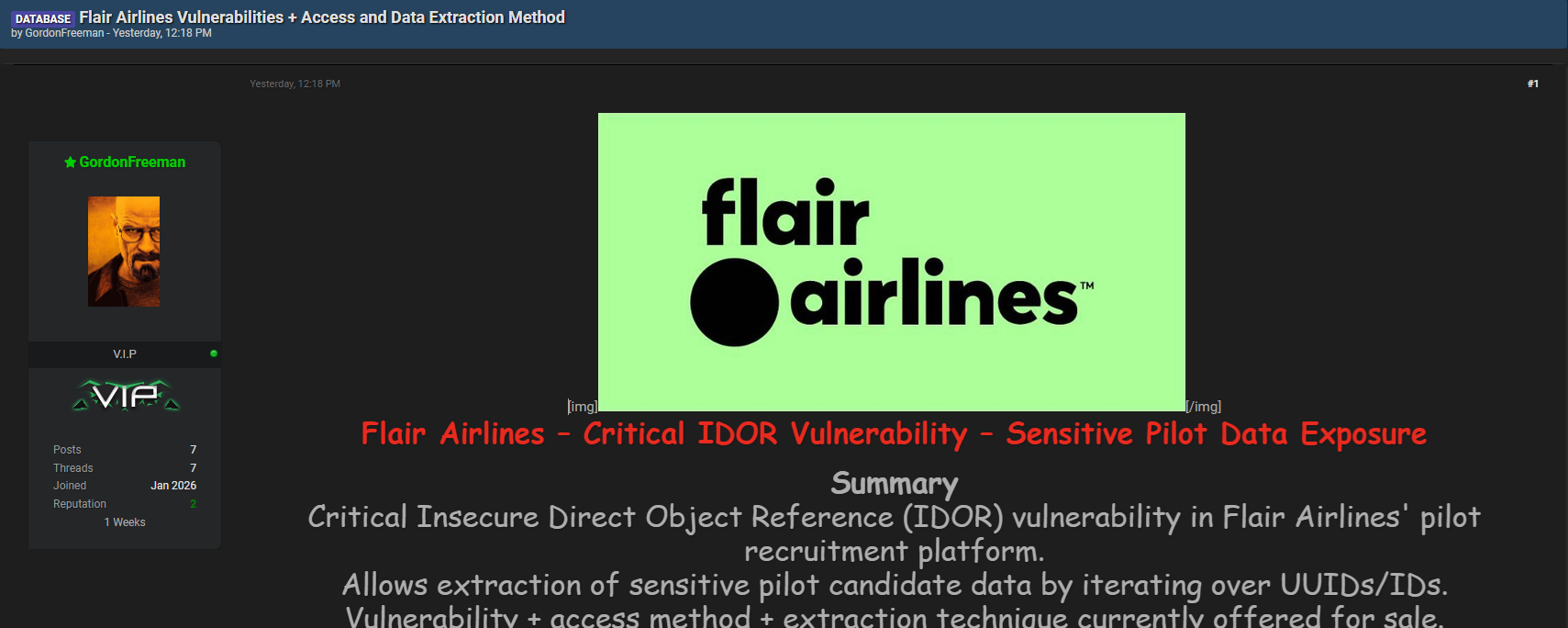

If accurate, this would place the incident among high-impact application security failures rather than isolated misconfigurations ⚠️.
Understanding the IDOR Vulnerability Risk
IDOR vulnerabilities are a common but dangerous class of access control flaws. They allow attackers to manipulate identifiers in requests to access data belonging to other users. The reported Flair Airlines vulnerabilities illustrate how a single oversight in authorization logic can expose an entire dataset. These flaws are particularly risky in platforms handling regulated or safety-sensitive roles, such as pilots, where personal and professional data must be strictly protected 🔍.
Compromised Pilot Candidate Data
The forum post lists a wide range of exposed fields tied to pilot candidates. These include names, email addresses, phone numbers, dates of birth, profile images, resumes, and language proficiency details. Additional attributes such as previous interview history, career type, gender, civil status, LinkedIn profiles, login timestamps, and consent flags were also reportedly accessible. When combined, these records create comprehensive personal profiles that can be abused for identity theft or targeted social engineering 📄.
Additional Metadata and Application Status Fields
Beyond core identifiers, the dataset allegedly contained backend metadata such as application status, missing or required fields, newsletter preferences, nationalities, country of residence, and location data. These details provide context that attackers can leverage to craft convincing phishing messages or impersonation attempts. Exposure of recruitment metadata also undermines the integrity of hiring processes and applicant trust 📊.
Access and Data Extraction Method Explained
According to the author, the access method relied on iterating over predictable or discoverable IDs within API endpoints. By modifying request parameters, an attacker could sequentially retrieve records associated with other candidates. This type of exploitation does not require advanced malware or credentials, making it accessible to a broader range of threat actors. The claim that the vulnerability and extraction technique are being sold suggests potential for rapid weaponization 💻.
Timeline and Threat Actor Claims
The leak was published on 05 February 2026 and attributed to “GordonFreeman,” a handle often used to signal technical credibility. The post emphasizes the critical nature of the flaw and positions the access method as a commercial offering. While independent verification is necessary, similar disclosures in the past have often preceded real-world exploitation, especially when detailed schemas are provided ⏱️.
Is This Vulnerability Confirmed?
Is the vulnerability officially confirmed by Flair Airlines?
As of now, the information is based on a dark forum disclosure and third-party reporting rather than an official statement. However, the specificity of the technical description increases credibility. Organizations should treat such claims as high-priority leads and investigate promptly rather than waiting for confirmation.
Risks to Candidates and the Airline
If the Flair Airlines vulnerabilities are accurate, affected candidates face risks including identity theft, employment-related fraud, and targeted scams. For the airline, consequences could include regulatory scrutiny, reputational damage, and potential impacts on operational trust. Aviation organizations operate in a high-assurance environment, making any lapse in data protection particularly serious 🛡️.
Regulatory and Compliance Considerations
Recruitment platforms process personal data subject to privacy regulations in multiple jurisdictions. Exposure of candidate information may trigger breach notification obligations and audits. Regulators often assess whether organizations implemented reasonable security controls and responded swiftly to known risks. IDOR vulnerabilities are well-documented, making them difficult to defend if left unaddressed 📜.
Practical Security Checklist for Preventing IDOR
Organizations can reduce IDOR risk by following proven practices:
- Enforce strict server-side authorization checks for every object request
- Avoid exposing sequential or predictable identifiers
- Implement rate limiting and anomaly detection
- Conduct regular application security testing and code reviews
- Log and monitor access to sensitive endpoints 🧩
This checklist is especially relevant for HR and recruitment systems handling sensitive applicant data.
The Role of Proactive Threat Intelligence
Early awareness of underground disclosures can dramatically shorten response time. Integrating dark web monitoring into security operations helps organizations detect mentions of vulnerabilities or access sales before exploitation escalates. Insights from dark web monitoring reports often inform patching priorities and incident response decisions. A comprehensive dark web solution enhances visibility across forums and marketplaces, while Dark Web Monitoring for MSSP providers allows managed teams to scale protection across multiple clients 🚀.
Learning from Similar Aviation Sector Incidents
Past aviation-related data exposures show that recruitment and vendor platforms are frequent weak points. Attackers often target these systems because they are externally accessible and may receive less scrutiny than core operational systems. Continuous security assessments and third-party risk management are therefore essential for airlines and their partners 🔄.
Conclusion: A Wake-Up Call for Application Security
The reported Flair Airlines vulnerabilities underscore how basic access control flaws can lead to severe data exposure when left unchecked. An IDOR vulnerability enabling mass extraction of pilot candidate data represents a critical risk for privacy, trust, and regulatory compliance. Whether confirmed or still under investigation, the disclosure highlights the need for rigorous application security testing and proactive intelligence monitoring. Organizations that act quickly, patch decisively, and communicate transparently can reduce harm and rebuild confidence 🔐.
Discover much more in our complete guide
Request a demo NOW
*Disclaimer: DarknetSearch reports on publicly available threat-intelligence sources. Inclusion of an organization in an article does not imply confirmed compromise. All claims are attributed to external sources unless explicitly verified.
Discover how CISOs, SOC teams, and risk leaders use our platform to detect leaks, monitor the dark web, and prevent account takeover.
🚀Explore use cases →