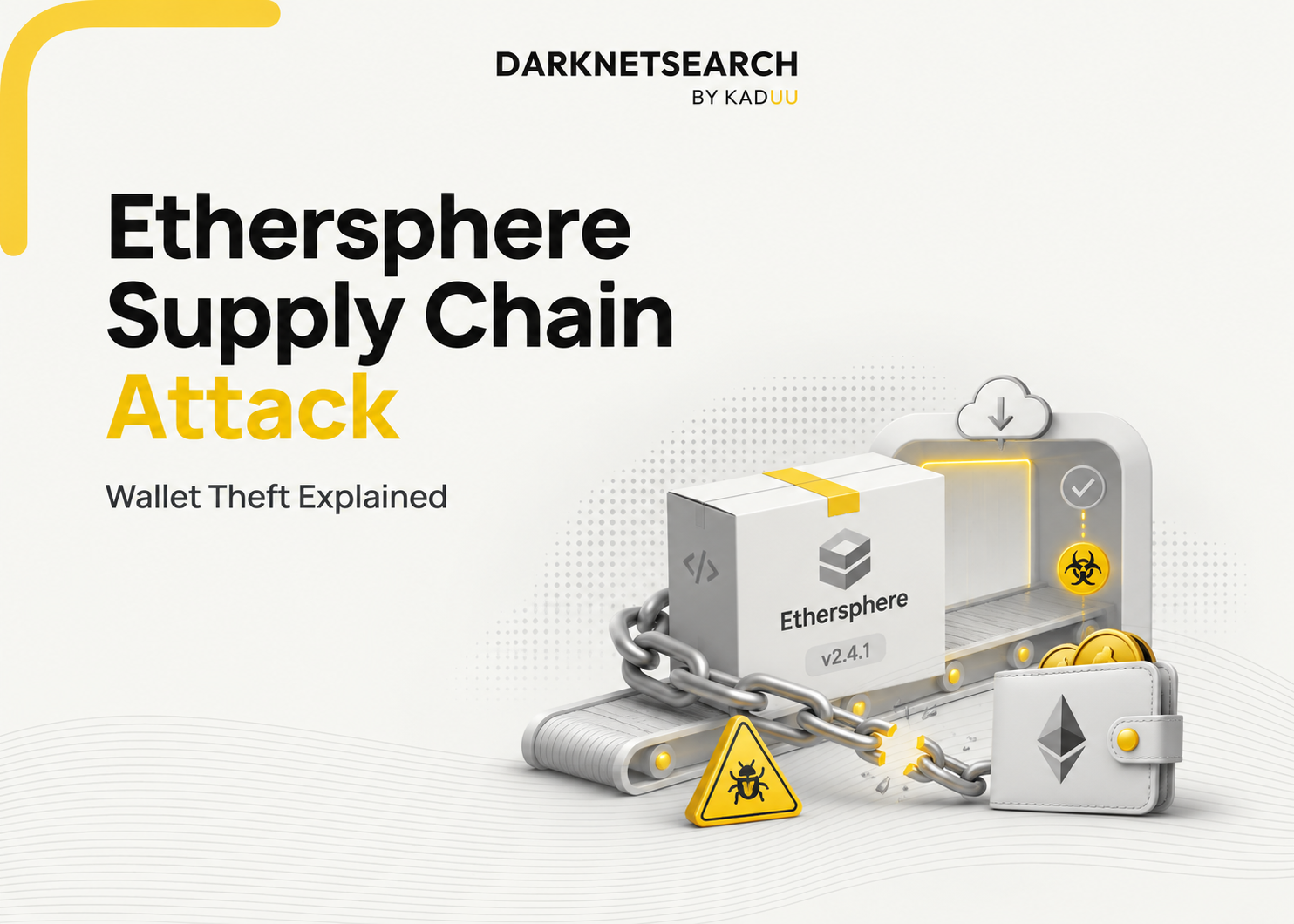
The Ethersphere supply chain attack exposed a serious weakness in trusted software distribution after attackers compromised legitimate release workflows to distribute wallet-stealing malware. On November 9, 2026, malicious versions of the bee-js JavaScript package and Swarm Desktop application were published through official channels. The incident demonstrates why external threat intelligence and credential exposure monitoring matter alongside traditional software security controls.
Security researchers identified malicious installation scripts, compromised release identities, and backdoor components targeting Windows, macOS, and Linux. For CISOs, SOC analysts, and development teams, the case illustrates how attackers can turn trusted software updates into mechanisms for credential theft, unauthorized access, and financial risk.
What Happened in the Ethersphere Supply Chain Attack?
The incident affected two components of the Ethersphere ecosystem, which supports the Swarm decentralized storage network.
The first was @ethersphere/bee-js, a JavaScript library used to interact with Swarm nodes. The second was Swarm Desktop, an application that allows users to operate Swarm nodes from their computers.
Attackers manipulated the project’s release infrastructure to publish malicious versions of both products.
The affected releases were:
- bee-js 13.3.0: A compromised npm package containing an installation-time malware loader.
- Swarm Desktop 0.56.2: A malicious desktop release containing similar functionality.
- Targeted information: Swarm wallet files and credentials required to access them.
- Additional threat: Backdoor installation enabling potential persistent access to compromised systems.
The malicious bee-js package was available through npm for approximately 75 minutes. Swarm Desktop 0.56.2 remained available for approximately eight and a half hours before withdrawal.
Both releases were removed, and a clean Swarm Desktop version, 0.56.3, was published.
At the time of the initial investigation, researchers had not established the total number of infected computers or confirmed financial losses.
How Did Attackers Compromise Ethersphere’s Software Releases?
The attack exploited trust in legitimate development and publishing infrastructure rather than relying on a conventional vulnerability in the application’s intended functionality.
According to Socket’s original investigation of the Ethersphere compromise, the attackers abused access associated with project maintenance and release automation.
1. Compromised identities enabled unauthorized publishing
Researchers identified suspicious activity involving Ethersphere’s bee-worker release automation account and a maintainer account.
The attackers used existing publishing workflows to produce malicious releases that appeared to originate from the legitimate project.
The precise origin of the compromised access credentials had not been established in the initial research.
2. Malicious code was inserted into bee-js
The attackers modified package configuration and introduced executable JavaScript into a script associated with version generation.
They added a postinstall lifecycle hook, allowing the malicious code to execute when vulnerable package-manager configurations installed the compromised dependency.
This meant an organization could potentially trigger the payload simply by installing the affected package, without explicitly importing it into application code.
3. A remote server delivered additional malware
The modified package contacted attacker-controlled infrastructure to retrieve additional JavaScript.
That code executed with the privileges of the installation process.
Depending on the environment, this could expose sensitive development resources, credentials, or local application data.
4. Swarm Desktop distributed a related payload
Attackers subsequently published Swarm Desktop 0.56.2 through the project’s release process.
The compromised version included malicious functionality inside the desktop application’s execution path.
This expanded the attack beyond developers installing npm packages to users running the desktop software.
How the Wallet-Stealing Malware Worked
The malicious components were designed to collect information associated with Swarm wallets and establish additional control over affected computers.
Cryptocurrency wallet credential theft
The malware targeted files associated with the Swarm node’s wallet configuration.
Researchers identified functionality designed to retrieve both encrypted wallet material and the password needed to unlock it.
Possession of these elements could potentially enable unauthorized access to the associated wallet.
However, the presence of credential-stealing functionality does not establish that every targeted wallet was successfully compromised.
Persistent remote access
The campaign also attempted to establish backdoor access.
On Linux and macOS, researchers identified a Go-based remote shell component. On Windows, the malicious activity included installation of a ScreenConnect remote access client.
Such functionality could allow attackers to maintain access after the original malicious installation.
Command-and-control infrastructure
Researchers identified infrastructure connections linking the campaign to previously documented malicious activity involving developer extensions.
The malware used a multi-stage execution process, complicating investigation because the initial package did not contain every malicious component directly.
These findings demonstrate how supply chain compromises can combine credential theft with longer-term endpoint access.
Why Stolen CI Credentials Create Serious Supply Chain Risks
One of the most important lessons from the Ethersphere incident concerns the security of continuous integration and continuous delivery environments.
CI/CD systems automate software building, testing, signing, and distribution.
These processes frequently rely on privileged accounts, service identities, and authentication tokens.
If attackers obtain sufficient access to these identities, they may manipulate legitimate release mechanisms.
The Ethersphere case is particularly significant because the compromised npm release carried valid provenance information generated through the project’s trusted publishing workflow.
A legitimate publishing workflow therefore does not automatically guarantee that the underlying released code is trustworthy.
Organizations should pay particular attention to:
- Release automation identities with excessive permissions.
- Long-lived credentials associated with development infrastructure.
- Software releases that bypass expected approval processes.
- Unreviewed changes to build scripts and package configuration.
- Unexpected installation hooks or external code downloads.
These risks require both technical safeguards and clear responsibilities for maintaining development infrastructure.
How Threat Intelligence Supports Supply Chain Investigations
The Ethersphere incident illustrates how internal security monitoring and external threat intelligence provide complementary information.
When a development environment is compromised, security teams need to determine what happened locally and whether stolen information has appeared elsewhere.
Investigating compromised credentials
DarknetSearch provides credential and stealer log monitoring capabilities that can support investigations involving exposed authentication information.
For example, an organization investigating a compromised developer account may need to determine whether related credentials have appeared in monitored external datasets.
However, there is no verified evidence that the CI credentials used in the Ethersphere attack originated from dark web marketplaces.
External monitoring should therefore be treated as an additional investigative resource, not proof of the attack’s initial access method.
Understanding related malware activity
Security teams can also benefit from identifying related malware families, malicious infrastructure, and patterns of credential theft.
DarknetSearch previously examined similar developer-focused risks in its article about North Korean npm supply chain attacks.
These incidents highlight how software ecosystems can become attractive targets when privileged development identities are compromised.
Strengthening human-centered security
Technical protections remain essential, but developers and administrators also need to recognize suspicious authentication requests, unexpected release changes, and unusual software behavior.
Practical security awareness training can reinforce credential-handling practices and encourage employees to report potential compromise quickly.
Education should complement, rather than replace, secure release pipelines and endpoint protection.
How Organizations Can Prevent Similar Software Supply Chain Attacks
The Ethersphere supply chain attack demonstrates the importance of securing the entire software delivery process.
Organizations should adopt a layered defensive strategy.
Protect privileged development identities
Use phishing-resistant multifactor authentication where supported and apply least-privilege access to repository administrators and release automation accounts.
Prefer short-lived credentials and tightly scoped workload identities over reusable tokens.
Review access permissions regularly, particularly for accounts capable of publishing production software.
Secure software release workflows
Require appropriate approvals for sensitive release operations.
Restrict publishing to authorized branches, tags, and validated commits.
Monitor unusual changes to GitHub Actions workflows, package configuration files, and automated release processes.
Monitor software dependencies
Maintain accurate inventories of installed packages and dependencies.
Analyze package changes before deploying new versions, particularly when installation scripts or unexpected network connections appear.
Software composition analysis and controlled build environments can help identify suspicious behavior.
Prepare for credential exposure
Organizations should maintain procedures for quickly revoking developer tokens, rotating secrets, and investigating unauthorized account activity.
External credential monitoring can support this process by providing additional visibility into information exposed outside corporate infrastructure.
What Should You Do If You Installed the Compromised Versions?
Organizations that installed bee-js 13.3.0 or Swarm Desktop 0.56.2 should treat affected systems as potentially compromised.
Recommended response actions include:
- Identify affected installations. Review dependency lockfiles, package caches, CI logs, and application version records.
- Contain potentially compromised systems. Isolate affected endpoints or build environments according to established incident-response procedures.
- Preserve forensic evidence. Retain relevant logs, process information, and installation artifacts before remediation.
- Rotate exposed credentials. Revoke tokens, passwords, and development secrets accessible to the compromised environment.
- Protect affected wallets. Transfer relevant assets to newly generated keys using a trusted device when wallet secrets may have been exposed.
- Replace malicious software. Remove affected versions and install verified clean releases.
- Investigate persistence. Examine systems for unauthorized remote access components and consider rebuilding compromised machines.
Updating software alone is not sufficient if malware has already established persistence or stolen credentials.
Incident responders should also assess whether affected CI environments had access to additional applications, cloud infrastructure, or production secrets.
Frequently Asked Questions
What is the Ethersphere supply chain attack?
The Ethersphere supply chain attack was a November 2026 compromise involving malicious versions of the bee-js npm package and Swarm Desktop application.
Attackers abused legitimate release infrastructure to distribute malware designed to steal wallet-related credentials and establish remote access.
The case illustrates how compromised publishing identities can undermine trust in legitimate software distribution channels.
Which versions of bee-js and Swarm Desktop were compromised?
Researchers identified bee-js version 13.3.0 and Swarm Desktop version 0.56.2 as malicious.
Both releases were withdrawn. The earlier bee-js version 13.2.0 was restored as the latest npm release, while Swarm Desktop 0.56.3 replaced the compromised desktop version.
Organizations should verify their dependency histories and deployment records rather than relying only on currently installed versions.
Were cryptocurrency wallets actually stolen?
Researchers confirmed that the malware was designed to extract wallet credentials and related files.
However, initial public reporting did not establish confirmed financial losses or a complete count of compromised wallets.
Organizations should treat potentially exposed wallet keys as compromised even when unauthorized transfers have not been observed.
Can dark web monitoring prevent supply chain attacks?
Dark web monitoring cannot directly prevent malicious package publication or replace secure development workflows.
It can help organizations investigate externally exposed credentials and related threat activity when relevant data is available.
The strongest protection combines identity security, secure CI/CD processes, dependency monitoring, endpoint detection, and external threat intelligence.
Strengthen Visibility Into Credentials and External Threats
The Ethersphere compromise demonstrates how attackers can exploit trusted development infrastructure to distribute malicious software and target sensitive credentials.
Organizations need more than secure build pipelines. They also need visibility into exposed identities, external threat activity, and potential downstream risks.
DarknetSearch helps security teams investigate compromised credentials, monitor external threat sources, and identify relevant exposure indicators.
Explore the platform and request a DarknetSearch free trial to understand how external threat intelligence can complement your existing security operations and support faster, evidence-based investigations.