eholo.health data leak: Key Facts and Security Impact

➤Summary
The eholo.health data leak has recently drawn attention across cybersecurity communities after a threat actor allegedly exposed sensitive healthcare information on an underground forum. According to claims published on darkforums.su on March 05, 2026, the breach involves over one million medical notes and hundreds of thousands of user records. Incidents like this highlight how vulnerable digital healthcare ecosystems can become when data protection fails. Healthcare organizations hold some of the most sensitive personal data available, making them prime targets for cybercriminal groups seeking profit or notoriety. This darknetsearch.com article examines what is currently known, analyzes potential risks, and explains how individuals and organizations can respond effectively. While the claims remain under investigation, the scale alone raises serious concerns for patients, providers, and cybersecurity professionals worldwide 🔎.
What Happened in the Alleged Incident
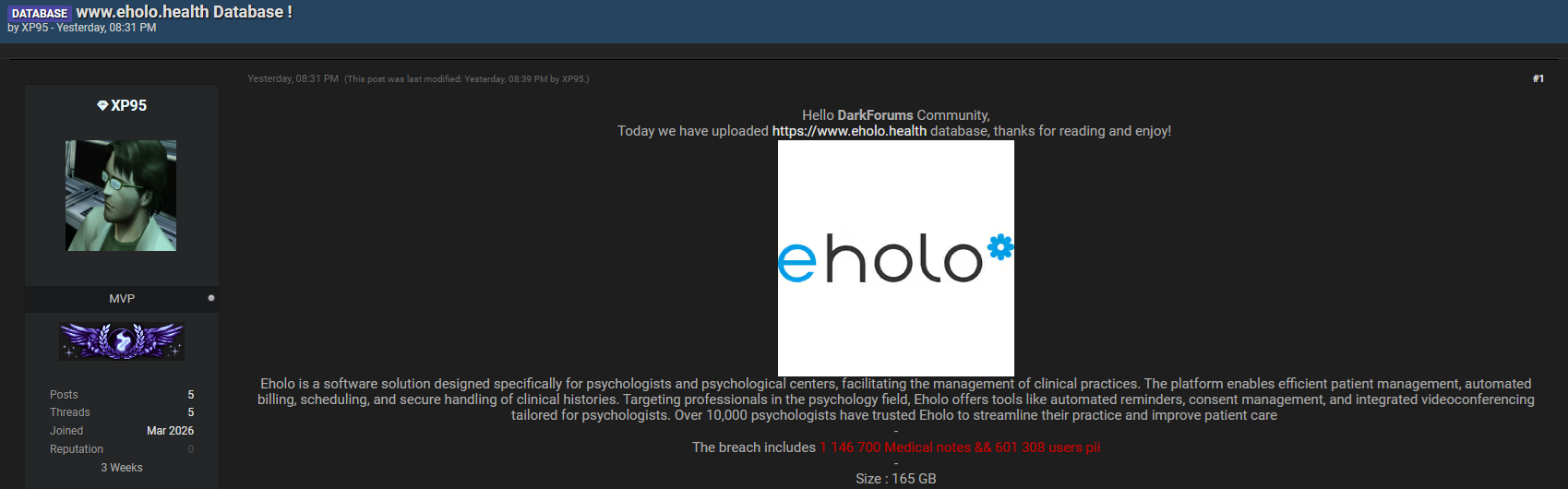
The alleged eholo.health data leak was first reported by a threat actor known as XP95 on the cybercrime forum darkforums.su. The post claims exposure of:

- 1,146,700 medical notes
- 601,308 user records
- Personally identifiable information (PII)
- Sensitive healthcare-related documentation
If accurate, this event would qualify as a major healthcare data breach affecting both clinical confidentiality and personal identity security. Medical records differ from typical corporate data because they combine identity, health history, and behavioral insights in one dataset. Cybercriminal marketplaces often value such information higher than financial credentials because it enables long-term exploitation. Analysts monitoring underground forums frequently observe attackers advertising stolen datasets before verification occurs, meaning claims should be treated cautiously until confirmed. Still, cybersecurity researchers note that even alleged leaks can trigger secondary attacks, including phishing and social engineering campaigns ⚠️.
Why Healthcare Data Is a Prime Target
Healthcare remains one of the most targeted industries for cybercrime due to the richness of stored information. Unlike passwords or credit cards, medical histories cannot easily be changed. Attackers exploit this permanence. A typical healthcare data breach may expose:
- Names and addresses
- Insurance identifiers
- Medical diagnoses
- Treatment records
- Contact information
These elements allow criminals to construct highly convincing fraud scenarios. Experts often emphasize that compromised medical data can fuel identity fraud for years. According to cybersecurity guidance published by https://www.hhs.gov/, healthcare organizations must adopt layered defenses because attacks increasingly target patient databases rather than infrastructure alone. The alleged eholo.health data leak demonstrates how a single exposure could affect both operational security and patient trust simultaneously 🧠.
Timeline and Threat Actor Profile
The forum publication date—March 05, 2026—marks the first known appearance of the dataset claim. Threat actor XP95 reportedly categorized the data under the healthcare sector and promoted it as a large-scale exposure. Underground actors often build reputations through verified leaks, meaning investigators typically analyze:
- Posting history
- Sample data authenticity
- Marketplace reputation scores
- Prior breach involvement
While no official confirmation has validated the dataset at the time of writing, cybersecurity teams conduct dark web surveillance to detect whether files circulate beyond the initial post. Early monitoring is crucial because leaked datasets frequently spread across multiple platforms within days. Organizations using an affordable dark web monitoring service can sometimes detect stolen data references before mass distribution occurs.
Potential Risks for Affected Users
If the claims prove accurate, individuals connected to eholo.health may face several cybersecurity risks. These risks extend far beyond immediate data exposure. Common consequences include:
- Targeted phishing attacks
- Medical identity fraud
- Insurance scams
- Account takeover attempts
- Social engineering campaigns
One major concern is credential reuse. Attackers often combine leaked personal data with password databases to launch automated login attempts across platforms. This is why credential stuffing prevention strategies are essential after any suspected healthcare data breach. Users may unknowingly expose multiple accounts if identical passwords were used elsewhere. The eholo.health data leak could therefore create ripple effects across unrelated services 🔐.
How Cybercriminals Monetize Medical Data
Medical datasets hold exceptional black-market value because they enable multiple revenue streams. Criminal groups typically monetize stolen healthcare information through:
- Direct data sales on underground forums
- Fraudulent insurance claims
- Prescription abuse schemes
- Targeted ransomware campaigns
- Identity resale bundles
Unlike financial data, healthcare information can be reused repeatedly. Attackers may revisit datasets months or even years later. Security researchers note that stolen medical notes provide contextual intelligence useful for crafting convincing scams. The healthcare data breach becomes especially relevant here because attackers increasingly shift toward long-term exploitation models rather than quick financial theft 💻.
Verification Challenges and Industry Response
One important question arises: Can alleged leaks be trusted immediately?
Answer: No. Cybersecurity experts verify breaches through forensic validation, victim confirmation, and dataset sampling before classification as confirmed incidents.
Many forum claims exaggerate dataset sizes to attract buyers or publicity. However, even exaggerated claims can still contain genuine records. Organizations typically respond by:
- Launching internal investigations
- Notifying regulators
- Monitoring underground activity
- Preparing public communication plans
Security teams often rely on identity theft monitoring solutions to identify whether exposed data appears in criminal marketplaces. Early response reduces reputational damage and protects affected individuals.
Practical Checklist: What Users Should Do Now
If you suspect involvement in a healthcare data breach such as the alleged eholo.health data leak, follow this practical checklist ✅:
- Change passwords immediately across healthcare and email accounts
- Enable multi-factor authentication (MFA)
- Monitor insurance statements for anomalies
- Watch for suspicious emails referencing medical information
- Use breach notification tools
- Avoid clicking unsolicited healthcare-related links
Proactive action significantly lowers the risk of follow-up attacks. Many security incidents escalate not because of the initial leak but because victims fail to respond quickly.
The Role of Proactive Monitoring Platforms
Organizations increasingly adopt proactive intelligence solutions to detect threats early. Continuous monitoring of underground marketplaces allows analysts to identify references to stolen datasets quickly such as healthcare data leak.
Broader Implications for Healthcare Cybersecurity
The healthcare sector faces growing digital transformation pressures, including telehealth adoption and cloud-based patient management. While these innovations improve accessibility, they also expand attack surfaces. Experts increasingly warn that cybersecurity must evolve alongside digital healthcare expansion. A healthcare data breach now affects not only hospitals but also third-party providers, software vendors, and patient-facing applications. The eholo.health data leak underscores a broader industry challenge: balancing accessibility with strong security governance. As one cybersecurity analyst noted, “Healthcare data is the new goldmine for cybercrime because it combines identity, finance, and personal history in one place.” 🧩
Long-term resilience requires:
- Continuous vulnerability testing
- Zero-trust architecture
- Employee awareness training
- Encryption and access controls
Without these measures, similar incidents are likely to continue emerging.
Key Warning Signs After a Data Exposure
Users often overlook early indicators that their information may be misused. Watch for:
- Unexpected password reset emails
- Medical bills for unknown treatments
- Insurance claim notifications you did not initiate
- Calls requesting verification of health data
Recognizing these signals early can prevent significant financial and emotional stress. Monitoring tools combined with personal vigilance remain the strongest defense after any alleged healthcare data breach 🛡️.
Conclusion: Lessons From the Alleged Incident
The alleged eholo.health data leak serves as a reminder that healthcare cybersecurity incidents can affect millions of individuals simultaneously. Whether fully verified or still under investigation, the scale of the claim demonstrates how attractive medical databases are to cybercriminals. Individuals should prioritize account protection and monitoring, while organizations must strengthen detection capabilities and response strategies. As digital healthcare continues expanding, proactive security measures will determine whether future incidents remain manageable or become large-scale crises. Staying informed, adopting monitoring solutions, and responding quickly are essential steps toward minimizing risk. 🚨
Discover much more in our complete guide
Request a demo NOW
Disclaimer: DarknetSearch reports on publicly available threat-intelligence sources. Inclusion of an organization in an article does not imply confirmed compromise. All claims are attributed to external sources unless explicitly verified.
Discover how CISOs, SOC teams, and risk leaders use our platform to detect leaks, monitor the dark web, and prevent account takeover.
🚀Explore use cases →