Darknet Search Engine Lessons from Polymarket’s $2.5M Breach
➤Summary
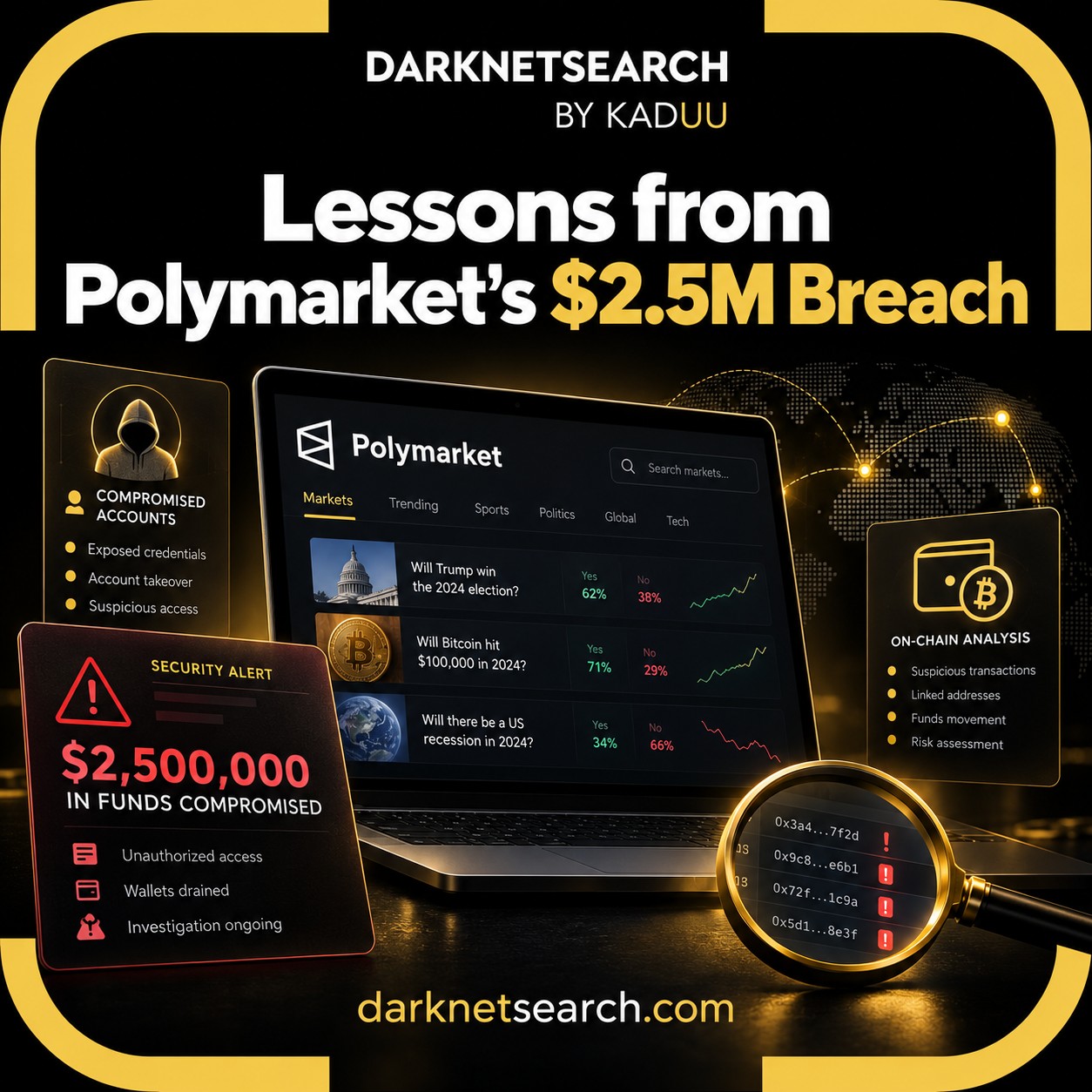
Darknet search engine intelligence can help security teams investigate exposed information following a cyber incident, but the Polymarket security incident of October 29, 2026, highlights a different problem: malicious code introduced through a third-party service can put user assets at risk without requiring a direct compromise of the platform’s core infrastructure. Polymarket temporarily halted trading after confirming that one of its providers had been compromised. Investigators traced approximately $2.5 million in cryptocurrency to a suspected attacker-controlled wallet, although the platform did not initially disclose the total confirmed losses or number of affected users. BleepingComputer’s incident report details the technical findings and reported response.
For cybersecurity professionals, the incident demonstrates why third-party JavaScript, browser-session security, supply-chain oversight, and external threat intelligence deserve attention alongside traditional vulnerability management. This article examines the reported attack, separates confirmed facts from investigative findings, and explains how organizations can strengthen their defenses.
What Happened in the Polymarket Security Incident?
On October 29, 2026, Polymarket temporarily restricted trading on its international platform after identifying a security issue involving a compromised third-party provider. The company announced that it had fixed the issue, referred the incident to law enforcement, and would reimburse affected traders.

According to BleepingComputer, researchers identified malicious JavaScript distributed through infrastructure associated with DebugBear, a website performance-monitoring service. The script reportedly attempted to manipulate authenticated trading sessions and transfer users’ cryptocurrency or prediction-market assets to an attacker-controlled wallet.
Polymarket initially placed its exchange in cancel-only mode and paused relayer actions while investigating. Its official incident status history records the investigation, mitigation, and resolution on October 29.
Trading subsequently resumed. However, restoring platform availability does not, by itself, establish the complete scope of an incident or confirm that every affected account has been remediated.
What Is Confirmed About the $2.5 Million in Traced Cryptocurrency?
Polymarket confirmed that a third-party provider had been compromised and stated that the issue affecting its international platform had been fixed. It also committed to making affected users whole.
BleepingComputer reported that blockchain activity associated with a suspected attacker wallet showed approximately 28.6 million POL, valued at around $2.57 million at the time of reporting, transferred to three additional wallets. The report also described transactions involving Polymarket’s prediction-market token contract shortly before trading was suspended.
These findings require careful interpretation.
- Confirmed by Polymarket: A third-party provider was compromised, the platform issue was fixed, trading was temporarily halted, and reimbursement was promised.
- Reported by security researchers: Malicious JavaScript was associated with the third-party service and appeared designed to manipulate user trading sessions and move assets.
- Observed through blockchain analysis: Cryptocurrency transactions were traced to a wallet identified as suspected attacker-controlled.
- Not fully established in the initial reports: The total confirmed financial loss, the complete number of affected users, the initial access method used against the provider, and the full scope of the provider’s compromise.
A wallet balance or transaction total is not necessarily equivalent to the final amount stolen. Funds may be moved, exchanged, or counted across multiple transactions, so investigators must avoid double-counting assets when estimating losses.
The incident also illustrates why technical evidence, company statements, and third-party research should be evaluated separately rather than treated as interchangeable proof.
How a Third-Party Script Can Become an Attack Path
Third-party JavaScript is commonly used for analytics, performance monitoring, customer support, advertising, and other website functions. Although these integrations can improve operations, they also introduce dependencies that organizations must govern and monitor.
When a website loads an external script, that code may execute within the visitor’s browser context. Depending on the application’s architecture, permissions, and security controls, malicious code can potentially interact with authenticated sessions or sensitive application functionality.
The Polymarket incident illustrates a supply-chain risk involving a trusted service rather than a conventional vulnerability in the primary application.
The reported attack chain can be summarized as follows:
- Third-party compromise: An external service was compromised, according to Polymarket.
- Malicious code distribution: Researchers identified a JavaScript file associated with the provider’s infrastructure.
- Browser-side activity: The script reportedly targeted authenticated sessions and attempted unauthorized asset transactions.
- Asset movement: Blockchain transactions were traced to a wallet identified as suspected attacker-controlled.
- Containment: Polymarket removed the affected integration, restricted trading, and reported the incident to law enforcement.
This sequence is based on published reporting, not a complete forensic reconstruction of the provider’s initial compromise.
The broader lesson is that vendor approval alone does not guarantee ongoing security. A previously trusted integration can become dangerous if its hosting infrastructure, publishing process, or access controls are compromised.
What Data and Assets May Be at Risk?
In this incident, the reported impact centered on cryptocurrency and prediction-market positions rather than a confirmed bulk database leak.
BleepingComputer’s analysis described malicious code that attempted to access account-related information, inspect holdings, manipulate trading positions, and transfer assets. It also reported communications involving wallet addresses, balances, and transaction results.
However, these technical findings do not establish that Polymarket’s entire user database, passwords, identity documents, or payment records were stolen. Those data categories should not be described as compromised without supporting evidence.
Security teams investigating a comparable incident should distinguish between several exposure types:
- Financial assets: Unauthorized transfers, token conversions, or liquidation of user positions.
- Session security: Potential misuse of authenticated browser sessions and application permissions.
- Account information: Data accessible to the malicious script during execution, subject to the application’s implementation.
- Third-party infrastructure: Potentially affected scripts, hosting services, monitoring endpoints, and connected customer environments.
- Operational evidence: Browser telemetry, application logs, authentication events, and blockchain transactions relevant to determining impact.
This distinction matters when deciding whether to investigate credential exposure, potential personal-data exposure, or financial theft. Different forms of compromise require different evidence and remediation.
Why Supply-Chain Security Requires Continuous Monitoring
A third-party provider can become a risk multiplier because one compromised service may be integrated into multiple customer websites. Organizations may have limited visibility into how those providers secure their development environments, deploy code, manage credentials, and respond to incidents.
The most effective response combines preventive controls with ongoing detection.
Security teams should maintain an inventory of externally loaded scripts and their owners, document why each integration is required, and remove unnecessary dependencies. Where supported, Subresource Integrity (SRI) can help browsers verify that a fetched resource matches an expected cryptographic hash. However, SRI is not suitable for every dynamic script and must be implemented with an appropriate update process.
Additional controls include:
- Apply a restrictive Content Security Policy (CSP) to limit which sources can execute scripts.
- Review third-party permissions and the application functions available to embedded code.
- Monitor changes to production scripts and investigate unexpected modifications.
- Separate sensitive transaction approval from analytics and other nonessential browser integrations.
- Review vendor security notifications and maintain a tested process for disabling compromised dependencies.
- Preserve relevant logs and establish procedures for identifying affected accounts and transactions.
These controls complement broader attack surface management practices. Knowing which services, domains, APIs, and external dependencies are part of the environment helps teams investigate risks that may not appear in a traditional internal asset inventory.
How a Darknet Search Engine Supports Incident Investigation
A darknet search engine can help investigators identify exposed information associated with a security incident by searching relevant underground forums, available leak collections, and other monitored sources.
It does not directly prove that a third-party script caused an incident or establish how much cryptocurrency was stolen. Instead, external threat intelligence can provide additional context about potential data exposure, related activity, and information circulating outside an organization’s trusted environment.
For example, following a supply-chain compromise, an investigation may include:
- Searching for company domains and relevant employee email addresses in available exposure datasets.
- Checking whether credentials associated with affected services appear in known breach collections or stealer logs.
- Investigating claims that attackers possess internal files, customer information, or access credentials.
- Correlating relevant findings with internal logs and verified incident indicators.
- Recording source references, timestamps, confidence levels, and remediation status.
DarknetSearch provides dark web and deep web threat intelligence covering exposed information and related external risks. Its relevance depends on the incident: a financial transaction attack may leave useful blockchain evidence without producing any discoverable database leak.
A negative search result should not be treated as proof that no compromise occurred. Criminal sources are fragmented, some information remains private, and not every incident results in publicly advertised stolen data.
When should teams use compromised data search?
A compromised data search is useful when investigators need to determine whether information connected to an organization appears in available exposure sources. This may include employee credentials, customer records, internal documents, or references to affected infrastructure.
After a third-party incident, teams should prioritize identifiers directly related to the affected service, vendor, and application. Findings should be validated before they trigger password resets, account restrictions, regulatory assessments, or external notifications.
This approach is complementary to endpoint detection, identity monitoring, SIEM analysis, and incident response. External intelligence can reveal evidence that internal tools do not collect, but it cannot replace investigation of the systems involved.
What Security Teams Should Do After a Third-Party Script Compromise
Organizations using a potentially affected vendor should act on verified advisories and their own dependency inventories rather than assuming that every customer of the provider experienced the same impact.
A practical response checklist includes:
- Identify dependencies. Determine whether affected scripts or services are deployed across production websites, customer portals, or transaction interfaces.
- Contain the exposure. Disable or remove confirmed affected integrations and follow the provider’s verified remediation guidance.
- Assess account impact. Review authentication events, application logs, browser activity, and transaction records for unauthorized actions.
- Protect user sessions. Revoke active sessions or refresh tokens where appropriate, and reset credentials if evidence indicates they were exposed.
- Review financial activity. Investigate unauthorized transfers, token swaps, position changes, and relevant wallet transactions.
- Preserve evidence. Retain affected script versions, deployment records, logs, timestamps, and relevant indicators for forensic analysis.
- Evaluate data exposure. Determine whether personal information or other regulated data was accessed, using evidence rather than assumptions.
- Monitor for follow-on activity. Search relevant exposure sources for associated credentials, datasets, or threat-actor claims, and validate any findings.
Organizations should also review vendor contracts, notification requirements, dependency approval processes, and recovery procedures. Legal and regulatory obligations depend on the facts, applicable jurisdiction, and type of information involved.
How to Check If My Data Is on the Dark Web After an Incident
The question “how to check if my data is on the dark web” is relevant when a security incident may have exposed employee accounts, customer records, or company information. The process begins by identifying the affected systems and the specific identifiers that could have been exposed.
Security teams can then search available breach intelligence, credential datasets, stealer logs, and underground discussions for relevant matches. A result should be assessed for its source, age, authenticity, and relationship to the incident.
DarknetSearch’s coverage of breach investigation and exposed-data risks provides additional context on how external exposure intelligence can support security investigations.
A useful investigation records what was found, where it appeared, whether the finding was independently validated, and what action followed. Avoid uploading sensitive credentials or confidential records to untrusted search services. Use approved investigative workflows and restrict access to any collected evidence.
Why Attack Surface Monitoring Matters Alongside Threat Intelligence
Attack surface monitoring and dark web intelligence address different parts of the same risk.
Attack surface monitoring identifies internet-facing assets, exposed services, misconfigurations, and other weaknesses that could create an entry point. External threat intelligence helps investigators understand whether relevant information or activity is appearing outside the organization’s trusted systems.
Combining these views can help teams prioritize investigations. For example, a newly discovered public-facing service may warrant closer examination if relevant credentials also appear in a stealer-log dataset. Neither finding independently proves that the service was compromised, but together they can support a more focused assessment.
DarknetSearch describes its attack surface discovery and monitoring capabilities as part of its broader external exposure offering.
For SOC teams and MSSPs, the practical objective is to correlate external findings with asset inventories, identity telemetry, endpoint alerts, and incident records. This creates a more useful picture of risk than treating each external alert as an isolated event.
Frequently Asked Questions
Was Polymarket’s entire platform hacked?
Polymarket confirmed a security incident involving a compromised third-party provider and temporarily halted trading on its international platform. Published research described malicious JavaScript targeting authenticated users and their assets. The available reporting did not establish that the entire platform or its complete user database was compromised. The distinction between a vendor-related attack path and a direct compromise of core infrastructure remains important.
Does a third-party JavaScript compromise mean passwords were stolen?
Not necessarily. Malicious JavaScript can potentially abuse the browser session and application functions available to it, but that does not automatically mean passwords or password databases were stolen. Investigators must determine what the script accessed, which actions it attempted, and what evidence exists of credential exposure. Session revocation, credential resets, and additional controls should be based on the confirmed risk.
Can a darknet search engine trace stolen cryptocurrency?
A darknet search engine primarily supports searches for exposed information and relevant threat intelligence. Cryptocurrency tracing relies on blockchain records and appropriate analytics tools. Investigators can combine these sources to enrich an investigation, but a wallet’s transaction history does not independently establish the attacker’s identity or prove the total amount lost by victims.
Can attack surface monitoring prevent third-party supply-chain attacks?
Attack surface monitoring can help identify exposed assets and weaknesses, but it cannot prevent every compromise of an external provider. Effective defense also requires vendor risk management, script controls, application security, identity protections, logging, and incident response. Continuous monitoring improves visibility and may help teams discover relevant exposures earlier, but its effectiveness depends on coverage, detection quality, and timely remediation.
Turn External Exposure Intelligence Into Actionable Security Decisions
The Polymarket incident demonstrates why security teams need visibility beyond their own infrastructure. A compromised third-party service can introduce malicious behavior into a trusted application, while blockchain analysis and forensic investigation help establish the resulting impact.
DarknetSearch can complement these efforts by helping organizations investigate exposed information and monitor relevant external threat sources. Explore Darknetsearch.com to assess how dark web intelligence and attack surface monitoring could support your existing security operations, alongside application security, identity controls, endpoint monitoring, and incident response.
Disclaimer: DarknetSearch reports on publicly available threat-intelligence sources. Inclusion of an organization in an article does not imply confirmed compromise. All claims are attributed to external sources unless explicitly verified.
Discover how CISOs, SOC teams, and risk leaders use our platform to detect leaks, monitor the dark web, and prevent account takeover.
🚀Explore use cases →