
Dark Web Surveillance: Alleged gotrestle.com Database Leak
➤Summary
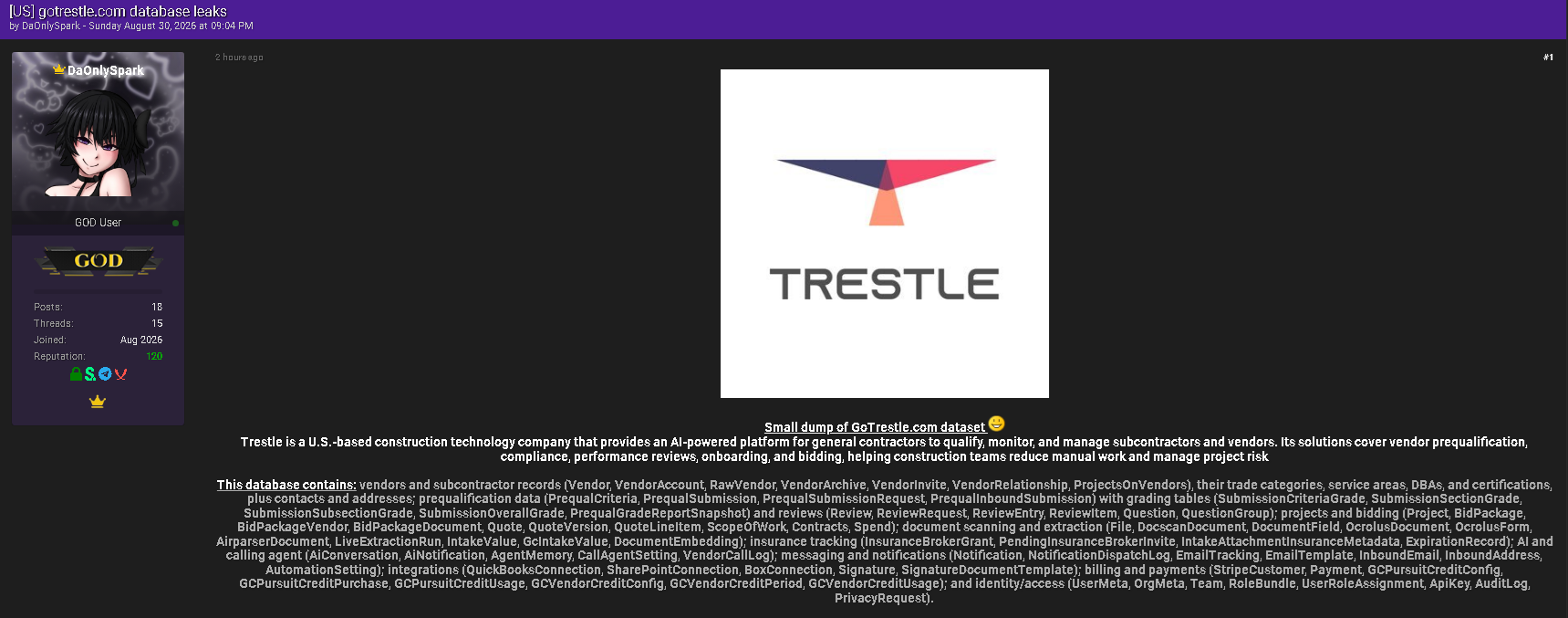
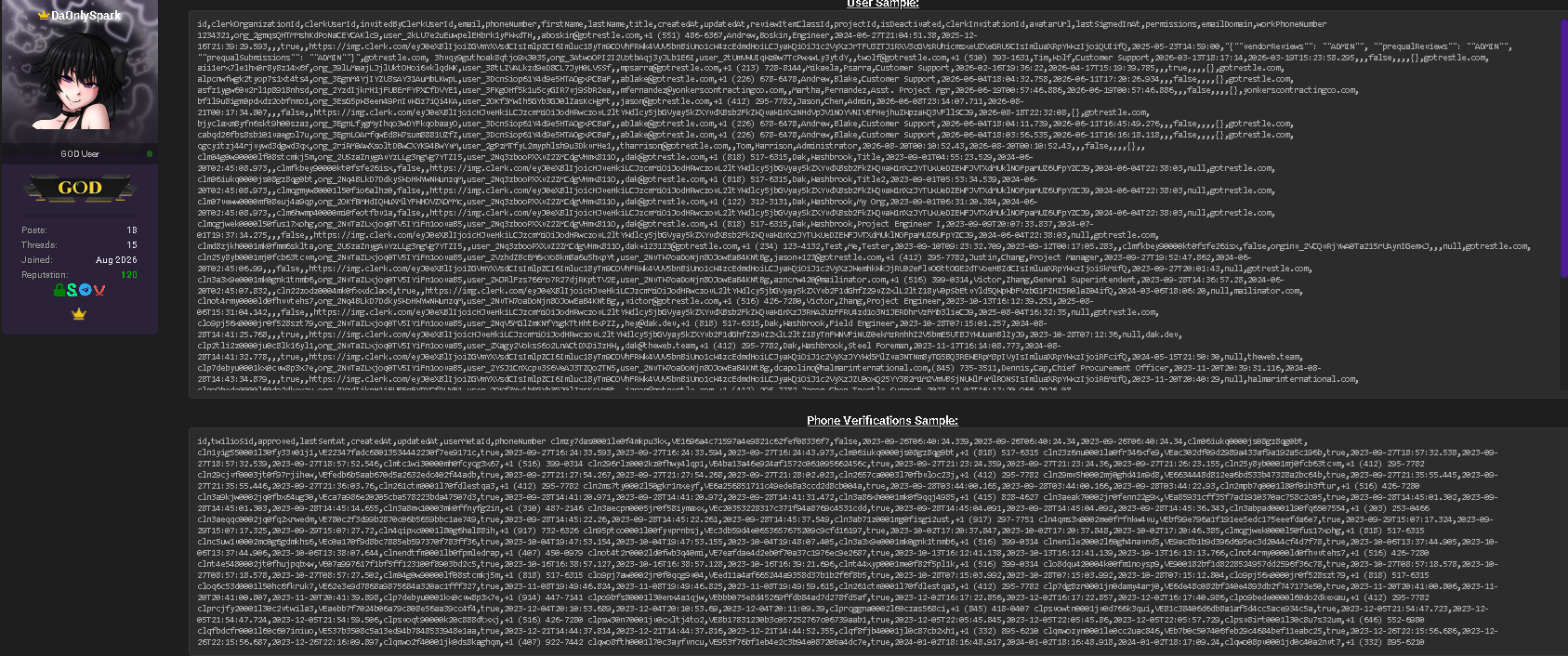
Dark web surveillance can help security teams investigate emerging claims about exposed business data before those claims become overlooked risks. On August 30, 2026, a post attributed to the username DaOnlySpark appeared on the cybercrime forum Pwnforums.st, alleging a database leak involving gotrestle.com. The claim has not been independently verified, and the available forum post should not be treated as proof that Trestle was breached.
The situation nevertheless deserves attention because Trestle operates a business platform for construction vendor management. Its official website describes services for general contractors involving vendor qualification, onboarding, compliance, bidding, and centralized vendor information.
For organizations conducting dark web threat intelligence for enterprises, the key issue is not simply whether a forum post exists. The more important questions are whether the claimed data is authentic, whether it belongs to the named organization, whether it is current, and whether any exposed information creates actionable security risk.

What Is the gotrestle.com Database Leak Claim?
The reported incident is an allegation published on Pwnforums.st on August 30, 2026, by a forum user identified as DaOnlySpark. The post is titled as a database leak involving gotrestle.com.
At the time of writing, this article treats the forum entry strictly as an unverified threat-actor or forum claim. No independent evidence reviewed for this article establishes that Trestle suffered a confirmed database compromise.
This distinction matters. Cybercrime forums frequently contain a mixture of authentic breaches, recycled datasets, fabricated claims, outdated information, samples from previous incidents, and attempts to attract buyers. Dark web monitoring therefore needs an analysis and verification layer rather than treating every underground post as a confirmed incident.
Trestle’s official website identifies the company as a provider of construction vendor-management services, while its privacy policy states that its services involve personal information collected in connection with its platform and website.
Those facts establish why a credible exposure claim would warrant investigation, but they do not establish that the information described in the forum post was actually obtained from Trestle.
What Is Confirmed and What Remains Unverified?
The available evidence should be separated into several categories.
Confirmed: A forum post attributed to DaOnlySpark was published on Pwnforums.st on August 30, 2026, concerning an alleged gotrestle.com database leak.
Confirmed: gotrestle.com is the website of Trestle, a construction vendor-management business. Its current website describes vendor qualification, compliance monitoring, bidding workflows, and centralized vendor information.
Not independently confirmed: That Trestle experienced a database breach.
Not independently confirmed: The authenticity, completeness, age, or origin of any data allegedly associated with the forum post.
Not established: That Trestle customers, vendors, employees, contractors, or other third parties were affected.
This approach is essential for responsible cyber threat intelligence. An underground listing can be a useful lead, but it is not automatically evidence of compromise.
Why Dark Web Surveillance Matters for Alleged Database Leaks
Dark web surveillance refers to underground forums monitoring, marketplaces, leak sites, credential-sharing communities, and other hidden sources for information relevant to an organization.
The objective is not simply to collect suspicious posts. Effective monitoring helps security teams identify, correlate, contextualize, and investigate potential exposure.
For a business such as Trestle, relevant indicators could include:
- Corporate domains and subdomains
- Employee email addresses
- Usernames associated with business accounts
- References to databases or applications
- Credentials or authentication material
- Customer or vendor information
- Mentions of the organization in criminal communities
- Reposted or recycled breach datasets
- Phishing infrastructure impersonating the company
Dark web monitoring should complement internal security telemetry rather than replace it. DarknetSearch explains that underground monitoring can provide visibility into leaked credentials, databases, and other exposed information, while also highlighting the need to distinguish useful findings from inaccurate or outdated material. dark web monitoring resources
What Could a Credible Exposure Mean for Trestle?
The potential impact depends entirely on what, if anything, was actually exposed.
Trestle’s privacy policy states that its services are designed for businesses and involve personal information connected with its services. Its platform also supports relationships between general contractors and vendors, which means an authentic compromise could potentially raise questions about information belonging to multiple business relationships.
However, that possibility should not be confused with evidence that such information was leaked.
If a database claim were subsequently validated, investigators would need to establish:
- Whether the data originated from Trestle.
- When the information was collected.
- Whether it represents current or historical records.
- Whether credentials or authentication-related information are included.
- Which individuals or organizations may be represented.
- Whether the information remains usable.
- Whether the data has appeared elsewhere.
- Whether affected accounts or systems show signs of unauthorized activity.
This process helps organizations protect business from dark web threats without triggering unnecessary incident-response activity based solely on an unverified allegation.
How Attackers Could Benefit From Genuine Exposed Data
If a database leak is eventually authenticated, criminals could potentially use exposed business information for several follow-on activities.
Credential information can support account takeover attempts, password reuse attacks, or targeted phishing. Business and vendor information can also provide useful context for social engineering, particularly when criminals can connect names, roles, organizations, and legitimate business relationships.
NIST recommends MFA as an important defense against credential compromise and specifically notes that phishing-resistant authentication provides stronger protection than some forms of traditional MFA.
The risk therefore extends beyond the original database. A genuine leak can become useful intelligence for subsequent attacks even when the initial dataset does not contain passwords.
What Security Teams Should Investigate
Organizations connected to Trestle should avoid assuming they are affected simply because a forum claim exists.
Instead, security teams can conduct a measured investigation:
1. Validate the claim
Determine whether samples or other evidence associated with the allegation can be authenticated through legitimate investigative processes. Avoid downloading or interacting with illicit material unnecessarily.
2. Search for organizational identifiers
Review threat intelligence for corporate domains, employee addresses, relevant usernames, and other legitimate indicators associated with the organization.
3. Review authentication telemetry
Look for unusual login patterns, impossible-travel events, unexpected password-reset activity, suspicious session behavior, or other indicators associated with account compromise.
4. Strengthen authentication
Ensure MFA is enabled for sensitive accounts and prioritize phishing-resistant authentication where practical. NIST identifies phishing-resistant authentication as an important improvement because some traditional MFA methods remain vulnerable to phishing.
5. Watch for impersonation
A database allegation can create opportunities for follow-on phishing campaigns. Security teams should monitor suspicious domains, impersonation attempts, and messages that misuse legitimate company or vendor relationships.
This is where brand protection software can complement broader threat intelligence by helping security teams identify external abuse of organizational identity.
Why Businesses Need More Than a Single Dark Web Search
A single search provides only a snapshot. Underground information can be copied, reposted, renamed, fragmented, or moved between forums and marketplaces.
Dark web surveillance becomes more valuable when organizations continuously correlate multiple indicators.
For example, a security team might discover an alleged database listing, then later identify a matching corporate email address in another source. A subsequent appearance of the same account in a credential collection would provide additional context for investigation.
This does not automatically prove that an account was compromised, but correlation can help analysts determine which findings deserve priority.
DarknetSearch’s data breach detection offering is designed around this broader exposure-monitoring use case, helping security teams investigate potential leaked information rather than relying solely on conventional perimeter visibility.
Dark Web Threat Intelligence for Enterprises
Enterprise threat intelligence programs increasingly need visibility beyond conventional security telemetry.
Internal tools can identify suspicious authentication activity, malware, vulnerabilities, and endpoint behavior. External intelligence can provide a different perspective by showing what information may be circulating among threat actors.
This is particularly relevant for organizations with large ecosystems of employees, customers, suppliers, contractors, and technology partners.
A mature program can combine:
- Dark web surveillance
- Credential exposure monitoring
- Data breach intelligence
- Attack surface monitoring
- Brand and domain abuse detection
- Vulnerability intelligence
- Incident response
- Identity and access controls
Security Checklist for the gotrestle.com Claim
Organizations investigating the allegation can use this defensive checklist:
- Treat the Pwnforums.st post as an unverified claim.
- Do not assume compromise without supporting evidence.
- Identify whether any alleged data matches legitimate organizational records.
- Review corporate authentication logs for suspicious activity.
- Reset confirmed compromised credentials.
- Revoke suspicious active sessions or tokens where appropriate.
- Ensure MFA protects important accounts.
- Prioritize phishing-resistant authentication for sensitive access.
- Monitor corporate domains and employee identities for further exposure.
- Watch for impersonation and phishing activity.
- Preserve relevant evidence for incident-response teams.
- Reassess findings as additional intelligence becomes available.
The goal is evidence-based risk reduction, not simply reacting to every criminal-forum allegation.
Frequently Asked Questions
Is the gotrestle.com database leak confirmed?
No. The information reviewed for this article confirms the existence of a forum post attributed to DaOnlySpark on August 30, 2026, but does not independently confirm that Trestle suffered a database breach. The alleged dataset’s authenticity, origin, scope, and currency should therefore be treated as unverified unless reliable evidence establishes otherwise.
Why monitor cybercrime forums for alleged leaks?
Cybercrime forums can provide early indications that attackers are claiming access to an organization or attempting to sell or distribute information. These claims are not automatically true, but they can serve as investigative leads. Security teams can correlate them with internal telemetry, credential exposure, known incidents, and other intelligence before deciding whether an incident-response process is warranted.
What should a company do after seeing an alleged database leak?
The first step is validation. Security teams should determine whether the alleged information is authentic and relevant before assuming compromise. They should also review authentication activity, investigate potentially affected accounts, strengthen MFA, monitor for phishing or impersonation, and continue external intelligence collection for related indicators.
Can dark web surveillance prove a breach occurred?
No. Dark web surveillance can identify claims, leaked information, exposed credentials, or other indicators that may support an investigation, but the appearance of data on an underground source does not automatically establish how it was obtained or whether an organization was compromised. Confirmation requires appropriate evidence and, where possible, independent validation.
Turn Dark Web Intelligence Into Actionable Visibility
The alleged gotrestle.com database leak demonstrates why businesses need to distinguish underground claims from confirmed incidents. Dark web surveillance can provide valuable external visibility, but its greatest value comes when findings are investigated, correlated, and connected to defensive action.
Organizations looking to strengthen their external intelligence can explore DarknetSearch’s monitoring capabilities to identify potential credential, database, marketplace, and underground exposure relevant to their business. Explore DarknetSearch dark web monitoring
Disclaimer: DarknetSearch reports on publicly available threat-intelligence sources. Inclusion of an organization in an article does not imply confirmed compromise. All claims are attributed to external sources unless explicitly verified.
Discover how CISOs, SOC teams, and risk leaders use our platform to detect leaks, monitor the dark web, and prevent account takeover.
🚀Explore use cases →