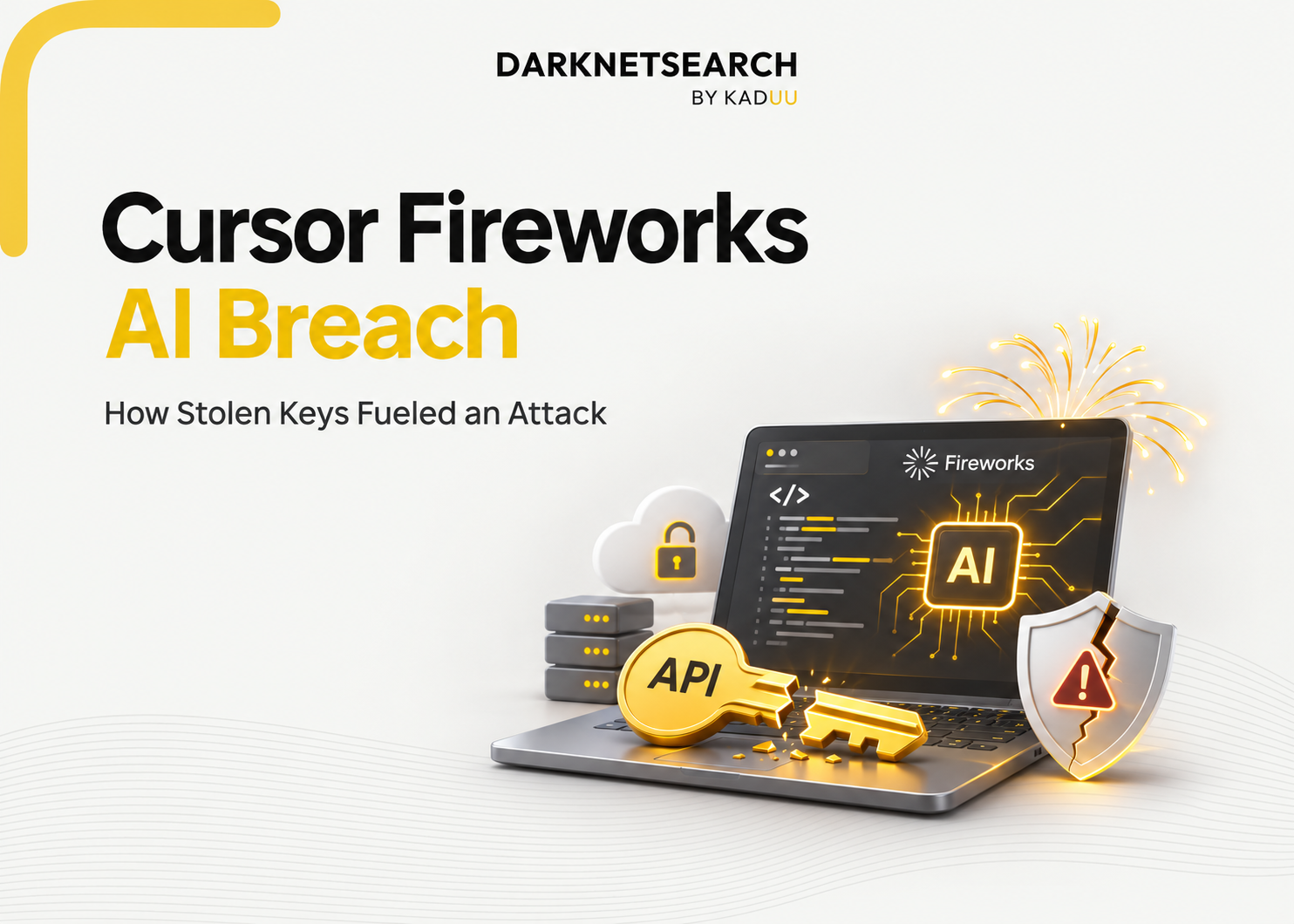
Cursor Fireworks AI breach investigations have revealed how a stolen third-party access key can trigger a series of compromises extending far beyond the original vendor. The incident exposed weaknesses in credential handling, AI coding-agent data retention, and software distribution security. For organizations seeking to monitor compromised credentials, the case highlights why external exposure detection must operate alongside internal security controls.
In November 2026, Cursor disclosed that attackers had used a key exposed through Fireworks AI to access historical coding-agent data and obtain additional credentials. The intrusion eventually enabled the distribution of malicious versions of Anthropic’s Claude Code extension through Cursor’s extension marketplace.
The incident provides an important lesson for CISOs, development teams, and managed security service providers (MSSPs): a credential exposed in one trusted relationship can become a pathway into entirely different systems.
What Happened in the Cursor Fireworks AI Breach?
The Cursor Fireworks AI breach involved unauthorized access that began with a key issued by Cursor to Fireworks AI, a third-party AI infrastructure provider.
According to Cursor’s official security incident report, published November 13, 2026, the attacker obtained that key after it was exposed on the provider’s side.
The compromised key allowed access to a read-only storage bucket containing historical AI coding-agent traces. These traces originated primarily from 2025 sessions where users had not enabled Privacy Mode.
Some records contained credentials that had not been properly redacted.
The attacker subsequently used those credentials to access selected SaaS tools and internal resources, eventually obtaining a credential that enabled interference with Cursor’s extension distribution infrastructure.
On October 29, malicious copies of Anthropic’s Claude Code extension were served through Cursor’s VS Code extension marketplace.
Cursor stated that the malicious builds were available for approximately 11 hours before removal.
How the attack progressed
The publicly documented sequence involved five stages:
-
Third-party credential exposure: An attacker acquired an access key that Cursor had issued to Fireworks AI.
-
Historical data access: The key provided access to a shared storage bucket containing coding-agent traces.
-
Secondary credential compromise: Unredacted credentials within some traces enabled access to additional SaaS tools.
-
Extension distribution compromise: Another stolen credential permitted the attacker to place unauthorized extension builds in the marketplace delivery cache.
-
Potential endpoint compromise: Developers requesting affected extension versions could receive malware designed to establish persistent access.
This progression demonstrates how credentials can connect systems that otherwise appear operationally separate.
What Data and Systems Were Affected?
Cursor’s investigation identified several categories of potentially exposed information.
These included archived non-production source repositories, limited customer support records, business contact information, product usage metrics, summaries of coding-agent conversations, and credentials previously shared with support personnel.
Cursor reported that fewer than 0.01% of customers had API credentials exposed through the coding-agent traces.
It also estimated that up to 5,000 users requesting specific extension versions during the attack window might have received a malicious build.
These figures represent different exposure categories. They should not be interpreted as proof that 5,000 devices were successfully compromised.
Cursor identified the affected extension versions as 2.1.312 and 2.1.313.
The malicious modifications attempted to install an SSH backdoor, potentially enabling unauthorized remote access.
Importantly, Cursor stated that its production systems, official application updates, customer code repositories, and data protected by Privacy Mode were not affected.
The company also clarified that Anthropic had not published the malicious extension and that the upstream Open VSX marketplace did not contain the malware.
Why Stolen API Keys Can Become a Supply Chain Threat
API keys are frequently used to connect applications, automation workflows, cloud services, and third-party infrastructure.
When properly managed, they provide controlled access to specific resources. When stolen, however, they can allow an attacker to operate through an apparently legitimate integration.
The danger depends on several factors:
-
Credential permissions: An overly privileged key may provide access to more information than its intended purpose requires.
-
Data sensitivity: Storage accessed through a restricted key can still contain highly sensitive records.
-
Secret retention: Historical logs and AI-generated traces may preserve credentials long after their original use.
-
Connected systems: Secondary credentials can create additional routes into cloud environments, SaaS platforms, and development infrastructure.
-
Credential lifecycle: Keys that remain valid after a security incident can extend the period of exposure.
The Cursor incident is particularly significant because the initial compromised key was associated with a third-party service rather than an ordinary employee account.
It illustrates why vendor access, data-sharing arrangements, and credential inventories must be included in enterprise security assessments.
How Credential Exposure Monitoring Supports Early Detection
Credential exposure monitoring helps security teams identify passwords, tokens, and other sensitive information appearing outside their expected environments.
Depending on the monitoring service and available evidence, this may include breach datasets, publicly exposed repositories, paste sites, infostealer logs, or underground sources.
The goal is to identify potentially actionable exposure and investigate whether affected credentials remain valid.
DarknetSearch provides capabilities for credential leak investigation and external threat monitoring. Its existing analysis of the Zeabur security breaches explains how previously exposed credentials can remain dangerous when they are not promptly invalidated.
However, not every credential theft produces a publicly discoverable leak.
In the Cursor incident, the initial exposure involved access through a third-party provider. There is no verified evidence that the stolen key was advertised or distributed on the dark web.
External monitoring should therefore complement internal log analysis, cloud security monitoring, and vendor incident notifications rather than replace them.
Protecting AI Development Environments From Credential Leaks
AI-assisted development environments introduce additional considerations because prompts, code fragments, debugging output, and execution traces may contain sensitive information.
Organizations should establish controls governing what information can be shared with AI services and how that information is stored.
Reduce sensitive data retention
Development teams should avoid including production secrets, authentication tokens, and confidential configuration information in prompts or debugging sessions whenever possible.
Privacy settings, retention policies, and third-party data-processing arrangements should also be reviewed.
Technical protections are equally important. Teams can implement automated secret scanning, restricted service permissions, and access policies that minimize the consequences of inadvertent disclosure.
DarknetSearch’s code exposure monitoring capabilities can help organizations investigate potentially exposed secrets in publicly accessible code-related sources.
For developers and other employees, targeted security awareness training can reinforce practical habits around sensitive information, AI tools, software extensions, and credential handling.
Such measures address different weaknesses. Training reduces avoidable mistakes, while technical controls help identify and limit their consequences.
What Security Teams Should Do After a Similar Incident
Organizations relying on AI development platforms should prepare response procedures that account for compromised integrations and malicious extensions.
A practical response plan includes the following steps.
1. Identify affected installations. Determine which users installed or updated software during the reported compromise window. Review extension versions, installation timestamps, and vendor notifications.
2. Investigate endpoint activity. Examine relevant security telemetry for unexpected processes, changes to SSH configurations, new authorized keys, and persistence mechanisms.
3. Revoke exposed credentials. Rotate potentially compromised API keys, access tokens, and service credentials. Review whether secondary credentials were stored in logs or historical development records.
4. Review third-party access. Identify vendor integrations with access to sensitive datasets. Restrict unnecessary permissions and validate storage-sharing configurations.
5. Verify trusted software sources. Check extension integrity, deployment channels, and relevant security advisories. Removing a malicious extension may not remove persistence already established on a device.
6. Continue exposure monitoring. Investigate new evidence of compromised credentials, leaked information, or suspicious activity associated with the organization.
For teams responding specifically to the Cursor incident, the vendor’s published remediation procedures and indicators should take precedence over general recommendations.
Why the Incident Matters for MSSPs and SOC Teams
Managed security service providers face a particular challenge: a single customer may depend on numerous cloud platforms, development tools, and third-party integrations.
Monitoring every relationship manually becomes increasingly difficult as the number of managed environments grows.
MSSPs can improve their response by maintaining client-specific inventories of critical services, privileged accounts, exposed credentials, and external assets.
An effective workflow combines three sources of evidence:
-
Internal telemetry: Endpoint detections, cloud activity logs, identity events, and SIEM alerts.
-
Vendor intelligence: Security advisories, incident notifications, and affected-product information.
-
External threat intelligence: Credential exposures, leaked datasets, suspicious code, and other relevant indicators discovered outside the customer’s environment.
When correlated, these sources provide a more comprehensive picture of risk.
For example, a suspicious external credential finding can be compared with identity-provider logs to establish whether unauthorized access occurred.
MSSPs should prioritize findings based on validity, privileges, affected systems, and potential business impact rather than treating every exposed credential as equally urgent.
Frequently Asked Questions
What caused the Cursor Fireworks AI breach?
According to Cursor’s investigation, the incident began when an attacker obtained an access key exposed through Fireworks AI. That key enabled access to historical coding-agent traces containing some unredacted credentials. The attacker used additional stolen credentials to reach internal systems and ultimately interfere with Cursor’s extension marketplace delivery infrastructure.
Was the official Claude Code extension compromised?
Cursor reported that attackers distributed unauthorized copies of Anthropic’s Claude Code extension through its marketplace cache. Anthropic did not publish the malicious builds, and the upstream Open VSX marketplace was not compromised. The incident affected a specific distribution channel rather than the legitimate extension’s official development process.
How many Cursor users were affected?
Cursor estimated that up to 5,000 users requesting specific extension versions on October 29, 2026, might have received malicious builds. This was an upper limit for potential distribution, not a confirmed number of successful malware infections. Cursor separately reported narrower exposure involving historical coding-agent traces and customer API credentials.
Can dark web monitoring detect stolen API keys?
Dark web monitoring can help identify exposed credentials when relevant information appears in monitored sources. However, privately stolen keys, inaccessible datasets, or credentials used directly by attackers may not be visible externally. Organizations should combine exposure monitoring with secret scanning, access auditing, anomaly detection, and prompt credential revocation.
Strengthen Visibility Into Exposed Credentials
The Cursor Fireworks AI incident demonstrates how a single third-party credential can create risks across connected services and software distribution systems.
Organizations cannot assume that internal security monitoring alone will reveal every instance of external exposure.
DarknetSearch helps businesses and MSSPs investigate compromised credentials, exposed code, and other external threat indicators through its security intelligence capabilities.
Combined with strong credential management, vendor security controls, and incident response, continuous monitoring can help security teams identify actionable risks and improve their visibility into potential threats.
Explore DarknetSearch to learn how external threat intelligence can strengthen your organization’s security operations.